Ichimoku Cloud Trading Strategy: The Complete All-in-One System
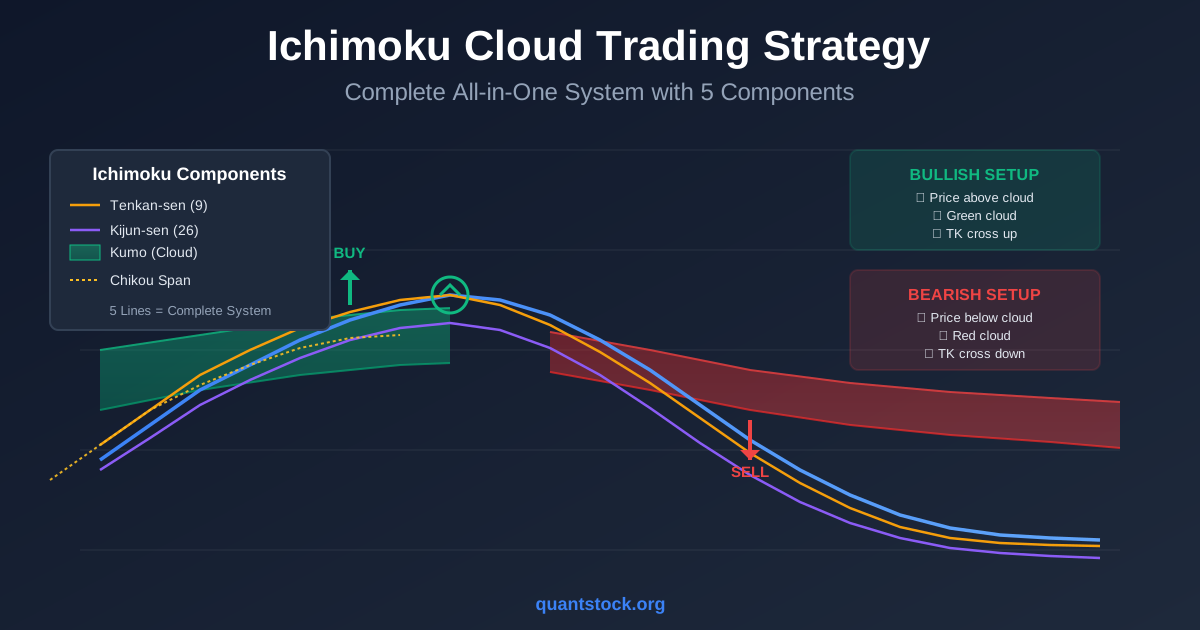
The Ichimoku Cloud is the Swiss Army knife of technical indicators—a complete trading system packed into a single indicator with five components. While most indicators only measure one dimension (momentum, trend, or volatility), Ichimoku simultaneously identifies trend direction, support/resistance levels, momentum, and trade timing. It looks intimidating at first glance, but once you understand how the components work together, Ichimoku becomes one of the most powerful tools in technical analysis.
In this comprehensive guide, you'll learn exactly how to read the Ichimoku Cloud, what each of the five components tells you, and how to use Ichimoku for complete trade setups from entry to exit. We'll cover the famous Kumo cloud twist signals, Tenkan/Kijun crossovers, and how to combine Ichimoku components for high-probability trades with clearly defined risk.
The beauty of Ichimoku is that it's a complete system—you don't need to layer on multiple indicators. Everything you need is already there: trend identification, dynamic support/resistance, momentum signals, and confirmation tools. Let's decode this Japanese masterpiece and learn how to trade it profitably.
What Is the Ichimoku Cloud?
Ichimoku Kinko Hyo (Japanese for "one glance equilibrium chart") was developed by journalist Goichi Hosoda in the late 1930s but not released publicly until 1968. Unlike Western indicators that focus on a single metric, Ichimoku provides a holistic view of the market by displaying past, present, and future price action simultaneously on one chart.
The Ichimoku system consists of five lines, but the most visually striking feature is the "cloud" (Kumo) formed between two of those lines. This cloud acts as dynamic support/resistance and visually represents market equilibrium. When price is above the cloud, the market is bullish. When below the cloud, bearish. When inside the cloud, the market is in transition or consolidation.
The Five Ichimoku Components:
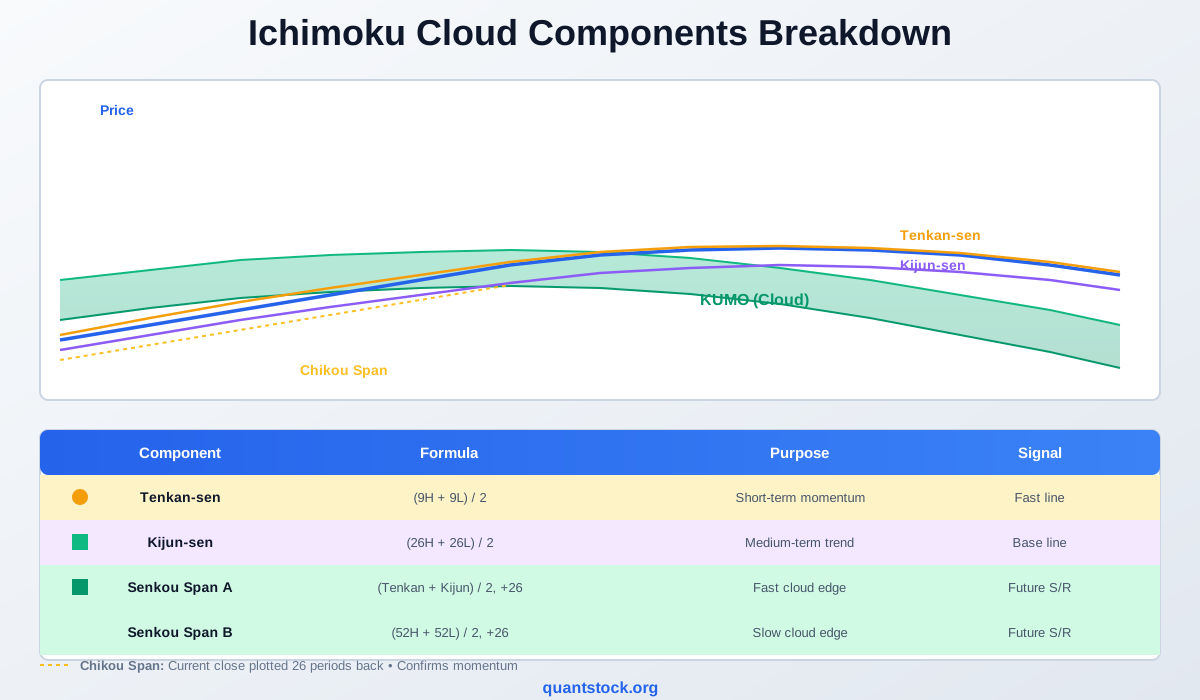
- Tenkan-sen (Conversion Line): (9-period high + 9-period low) / 2 — Fast-moving baseline showing short-term momentum
- Kijun-sen (Base Line): (26-period high + 26-period low) / 2 — Medium-term baseline showing equilibrium and trend direction
- Senkou Span A (Leading Span A): (Tenkan-sen + Kijun-sen) / 2, plotted 26 periods ahead — Forms the faster cloud boundary
- Senkou Span B (Leading Span B): (52-period high + 52-period low) / 2, plotted 26 periods ahead — Forms the slower cloud boundary
- Chikou Span (Lagging Span): Current closing price plotted 26 periods behind — Confirms trend and momentum
The cloud (Kumo) is the area between Senkou Span A and Senkou Span B. When Span A is above Span B, the cloud is bullish (usually colored green). When Span B is above Span A, the cloud is bearish (usually colored red). The thickness of the cloud indicates support/resistance strength—thick clouds are harder to break, thin clouds are easier.
Key Insight: The Ichimoku Cloud is projected 26 periods into the future, showing you where support/resistance is likely to be tomorrow, not where it was yesterday. This forward-looking nature makes it uniquely predictive.
How to Read the Ichimoku Cloud
Understanding Ichimoku starts with price position relative to the cloud. This single observation tells you the overall market bias and whether you should be looking for longs, shorts, or staying out entirely.
Bullish Signals (Look for Longs):
- Price is above the cloud (Kumo)
- Cloud is green (Senkou Span A above Span B)
- Cloud is sloping upward
- Tenkan-sen is above Kijun-sen
- Chikou Span is above price from 26 periods ago and above the cloud
Bearish Signals (Look for Shorts):
- Price is below the cloud
- Cloud is red (Senkou Span B above Span A)
- Cloud is sloping downward
- Tenkan-sen is below Kijun-sen
- Chikou Span is below price from 26 periods ago and below the cloud
Neutral/Avoid (Consolidation):
- Price is inside the cloud (choppy, no clear trend)
- Cloud is flat or horizontal (no directional bias)
- Tenkan and Kijun are intertwined (no momentum)
- Chikou Span is trapped inside the cloud from 26 periods ago
When all five components align—price above cloud, green cloud, Tenkan above Kijun, Chikou above price and cloud—you have maximum bullish confirmation. These aligned setups produce the highest win rates and largest moves. Inverse for bearish alignment.
The Tenkan-Kijun Cross Strategy
The most popular Ichimoku entry signal is the Tenkan-sen/Kijun-sen crossover. This works similarly to a moving average crossover but with Ichimoku's unique midpoint calculations. The cross signals a shift in short-term momentum relative to medium-term equilibrium.
Bullish TK Cross Setup:
- Price is above the cloud (confirms bullish trend)
- Tenkan-sen (fast line) crosses above Kijun-sen (slow line)
- Crossover occurs above the cloud (not inside it, which is weak)
- Cloud is green and expanding (trend is strengthening)
- Enter long on the cross or on a pullback to Kijun-sen
Bearish TK Cross Setup:
- Price is below the cloud
- Tenkan-sen crosses below Kijun-sen
- Crossover occurs below the cloud
- Cloud is red and expanding
- Enter short on the cross or on a rally to Kijun-sen
Stop Loss Placement: Use the cloud edge as your stop. For long trades above the cloud, place stops just below the top of the cloud (Span A or B, whichever is higher). If price breaks back into the cloud, the trend is failing and you want to exit immediately. This creates dynamic, volatility-adjusted stops that tighten during low volatility and widen during high volatility.
The strength of TK cross signals depends on where they occur. Crosses above/below the cloud in trending markets are strong. Crosses inside the cloud are weak and often fail. Crosses right at the cloud edge require additional confirmation (volume, candlestick pattern, Chikou Span clearance).
The Kumo Cloud Breakout Strategy
Cloud breakouts signal major trend changes. When price breaks through a thick cloud, especially after extended consolidation inside it, powerful moves often follow. The cloud acts as resistance on breakouts and support on breakdowns, so penetrating it shows genuine momentum shift.
Bullish Kumo Breakout:
- Price has been trading below or inside the cloud (bearish or neutral)
- Strong candle breaks above the cloud with momentum (close well above cloud top)
- Ideally the cloud is thin at the breakout point (easier to penetrate)
- Cloud color is changing from red to green (Kumo twist happening)
- Enter long on the breakout close or on first pullback to the cloud (now support)
- Stop below the cloud bottom
Kumo Twist Signal:
A Kumo twist occurs when Senkou Span A and Span B cross each other, changing the cloud from green to red (or vice versa). This signals a shift in medium-term trend direction. Kumo twists are early warning signs—they happen before price breaks through the cloud in many cases. When you see a Kumo twist with price still inside or just exiting the cloud, prepare for a new trend.
The most powerful setups combine multiple Ichimoku signals: a Kumo twist, TK cross, price breakout above/below cloud, and Chikou Span clearance all happening within a few candles of each other. These "perfect storm" Ichimoku setups often lead to 100+ pip moves in forex or multi-percent swings in stocks.
Using Chikou Span for Confirmation
The Chikou Span (lagging line) is the most underutilized Ichimoku component but one of the most powerful for confirmation. It plots the current closing price shifted 26 periods back in time. This creates a unique visual: if Chikou Span is above the price from 26 periods ago, it confirms bullish momentum. If below, it confirms bearish momentum.
Chikou Span Confirmation Rules:
- Bullish Confirmation: Chikou Span is above historical price and above the cloud from 26 periods ago. This shows price is making higher highs and breaking through previous resistance levels
- Bearish Confirmation: Chikou Span is below historical price and below the cloud from 26 periods ago. Price is making lower lows and breaking previous support
- Warning Signal: Chikou Span collides with historical price or gets stuck inside the cloud from 26 periods ago. This shows lack of momentum and warns against taking new positions
Before entering any Ichimoku trade, check that Chikou Span has "room to run"—meaning it's not about to collide with a previous price congestion zone or cloud. If Chikou Span has clear space above/below it in the direction of your trade, the move has room to develop. If Chikou Span is approaching heavy resistance/support from 26 periods ago, the trade may stall.
Many traders add Chikou Span as the final filter: only take TK cross signals or cloud breakouts when Chikou Span confirms by being cleanly above (bulls) or below (bears) the historical price action and cloud.
Kijun-sen Bounce Strategy
In strong trends, price tends to respect the Kijun-sen (base line) as dynamic support or resistance. When price is trending above the cloud, pullbacks to the Kijun-sen create low-risk long entry opportunities. This is similar to VWAP bounce strategies but with Ichimoku's midpoint calculation instead of volume weighting.
Kijun Bounce Long Setup:
- Price is in a strong uptrend (above cloud, green cloud, Tenkan above Kijun)
- Price pulls back to touch the Kijun-sen line
- Kijun-sen is flat or rising (not falling, which signals weakening trend)
- Chikou Span remains above historical price (confirms momentum intact)
- Enter long on bullish rejection of Kijun-sen (hammer, engulfing, strong close)
- Stop below Kijun-sen or below the cloud
The Kijun-sen acts as the "center of gravity" for price. In trends, price oscillates around Kijun-sen, bouncing off it repeatedly. Each bounce offers a re-entry opportunity to join the trend at favorable prices. Compare this to VWAP strategies in our VWAP trading guide to see similarities in how institutional and technical traders use dynamic midpoints.
When price breaks below Kijun-sen and stays below it for multiple candles, it signals trend exhaustion. In an uptrend, if price can't reclaim Kijun-sen, expect further decline toward the cloud. This makes Kijun-sen an excellent trailing stop level—hold longs while price is above Kijun, exit when it closes firmly below.
Ichimoku Cloud Settings and Timeframes
The default Ichimoku settings (9, 26, 52) were optimized for Japanese markets which traded 6 days per week. These numbers correspond to 1.5 weeks, 1 month, and 2 months of trading. Many Western traders adjust settings for 5-day markets, but the defaults still work remarkably well across all markets.
Standard Settings (9, 26, 52):
- Tenkan-sen: 9 periods
- Kijun-sen: 26 periods
- Senkou Span B: 52 periods
- Chikou Span: 26 periods displacement
- Cloud displacement: 26 periods ahead
Alternative Settings for Faster Signals (7, 22, 44):
Some traders use 7/22/44 to account for Western markets. This makes signals slightly faster and more sensitive. Test both on your preferred instruments through backtesting to see which generates better results.
Best Timeframes for Ichimoku:
- Daily Charts: Ichimoku's sweet spot. Developed for daily charts, it produces the cleanest signals here with minimal false signals. Ideal for swing trading
- 4-Hour Charts: Works well for active day traders and position traders. Provides good balance between signal frequency and reliability
- 1-Hour Charts: Usable but noisier. Requires stricter confirmation from all five components to avoid whipsaws
- Weekly Charts: Excellent for identifying major, multi-month trends. Used by investors and long-term position traders
- Avoid on timeframes below 1-hour: Ichimoku becomes too choppy on 15-min and 5-min charts, generating excessive false signals
Test Ichimoku strategies across different timeframes using our free backtesting platform to measure which settings and timeframes produce the highest Sharpe ratio and profit factor for your trading style.
Complete Ichimoku Trading System
Here's a rules-based Ichimoku system you can implement immediately, combining the strongest signals from all five components:
Long Entry Rules (All Must Align):
- Price is trading above the cloud (bullish regime)
- Cloud is green (Senkou Span A > Span B)
- Tenkan-sen crosses above Kijun-sen OR price bounces off Kijun-sen
- Chikou Span is above price from 26 periods ago
- Chikou Span has clear space above it (not approaching resistance)
- Enter on the TK cross or on Kijun bounce confirmation candle
Short Entry Rules (All Must Align):
- Price is trading below the cloud
- Cloud is red (Senkou Span B > Span A)
- Tenkan-sen crosses below Kijun-sen OR price rejects Kijun-sen
- Chikou Span is below price from 26 periods ago
- Chikou Span has clear space below it (not approaching support)
- Enter on the TK cross or Kijun rejection confirmation
Stop Loss Management:
- Initial stop: Below the cloud (for longs) or above the cloud (for shorts)
- As trade develops: Trail stop to the cloud edge as it moves with price
- Alternative: Use Kijun-sen as trailing stop (tighter but more frequent exits)
- Exit immediately if price closes inside the cloud (trend invalidated)
Profit Targets:
- Take partial profits when price reaches the opposite edge of the cloud (if cloud is thick)
- Let runners ride until Tenkan/Kijun cross in the opposite direction
- Exit if Chikou Span collides with historical price resistance
- For aggressive traders: hold until price closes inside or through the cloud
Enhance Your Ichimoku Strategy
ADX Indicator: Confirm Trend Strength
Ichimoku identifies trend direction beautifully, but ADX tells you if the trend is strong enough to trade. Only take Ichimoku signals when ADX is above 25, filtering out weak trends where the cloud may produce whipsaws.
Learn ADX Filtering →VWAP Trading Strategy
Like Kijun-sen, VWAP acts as a dynamic midpoint that price gravitates toward. Combine Ichimoku trend bias (above/below cloud) with VWAP bounces for precise intraday entries in the direction of the larger Ichimoku trend.
Master VWAP Bounces →Parabolic SAR: Dynamic Stops
Ichimoku cloud edges provide natural stop levels, but Parabolic SAR offers an alternative trailing stop system. Use Ichimoku for entry direction, then let SAR trail your stops automatically as trends extend beyond the cloud.
Learn SAR Trailing Stops →Frequently Asked Questions
What are the best Ichimoku Cloud settings?
The default settings (9, 26, 52) work best for most markets and timeframes. These were optimized by the indicator's creator Goichi Hosoda through decades of testing. Some traders adjust to (7, 22, 44) for Western markets, but backtesting shows the default settings remain robust. Avoid over-optimizing settings—the power of Ichimoku is in how the components interact, not the exact periods used.
What does it mean when price is inside the Ichimoku Cloud?
Price inside the cloud signals indecision or consolidation—no clear trend. These are periods to avoid trading or wait for confirmation. When price is trapped in the cloud, it's battling between support and resistance with no clear winner. Wait for a decisive break above or below the cloud before entering positions. Trades taken inside the cloud have significantly lower win rates.
How do you use Ichimoku Cloud for day trading?
For day trading, use Ichimoku on 4-hour or 1-hour charts to identify the trend, then drop to 15-minute charts for precise entries. Only take intraday trades in the direction of the higher timeframe cloud—longs when daily price is above the daily cloud, shorts when below. Use Kijun-sen bounces on the lower timeframe for entries while respecting the higher timeframe cloud as your trend filter.
What is a Kumo twist and how do you trade it?
A Kumo twist occurs when Senkou Span A and Span B cross, changing the cloud color from green to red or vice versa. This signals a medium-term trend reversal. The strongest Kumo twist setups happen when price simultaneously breaks through the cloud in the direction of the twist. Trade Kumo twists by entering in the new cloud color direction once price confirms by breaking out of the cloud.
Should you use Ichimoku Cloud with other indicators?
Ichimoku is a complete system and doesn't require additional indicators, but it combines well with ADX (trend strength filter), volume analysis (confirm breakouts), and RSI/MACD (momentum confirmation). Avoid cluttering your chart with too many indicators—Ichimoku already provides trend, support/resistance, and momentum. If you add indicators, use them sparingly to confirm what Ichimoku is already telling you.
Conclusion: Master Ichimoku for Complete Market Analysis
The Ichimoku Cloud is the most comprehensive single indicator in technical analysis, providing everything you need for complete trade setups in one visual system. By learning to read the relationship between price, cloud, Tenkan/Kijun lines, and Chikou Span, you gain immediate insight into trend strength, momentum, and support/resistance—all at a glance.
The key to Ichimoku mastery is patience and alignment. Don't force trades when only 2-3 components align. Wait for all five elements to confirm in the same direction—these "perfect storm" setups produce the highest win rates and largest moves. When price is above a green cloud, Tenkan above Kijun, and Chikou Span has clear space, you have maximum confirmation for longs. These are the trades worth taking.
Ready to test Ichimoku strategies with real historical data? Start backtesting now to validate which Ichimoku signals work best for your trading style, timeframe, and markets. Measure win rates for TK crosses vs Kumo breakouts vs Kijun bounces to build a data-driven edge with this powerful Japanese system.