Parabolic SAR Trading Strategy: How to Use Stop and Reverse Signals
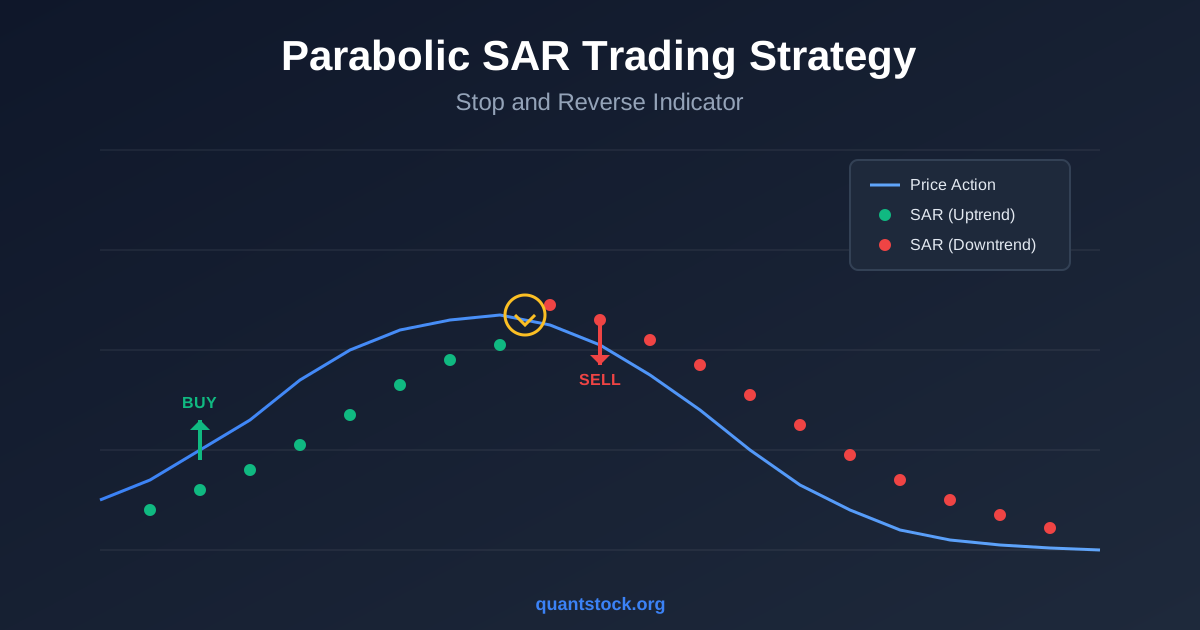
The Parabolic SAR (Stop and Reverse) is one of the most visually intuitive trend-following indicators in technical analysis. Those little dots above and below price action don't just look nice—they give you precise entry signals, trailing stop loss levels, and early warnings when trends are about to reverse. Unlike lagging indicators that tell you what already happened, Parabolic SAR adapts in real-time as price moves, making it perfect for active traders who need dynamic guidance.
In this comprehensive guide, you'll learn how to use the Parabolic SAR trading strategy for trend following, when SAR flips signal genuine reversals vs false signals, and how to optimize the acceleration factor for different markets and timeframes. Created by J. Welles Wilder (the same technical genius behind RSI, ADX, and ATR), Parabolic SAR has stood the test of time because it combines trend identification with built-in risk management.
The key advantage of SAR is its simplicity—dots above price mean short, dots below price mean long. No complex calculations to interpret, no subjective line drawing. Just objective, actionable signals that adapt as the trend accelerates. Let's explore exactly how to integrate Parabolic SAR into your trading system for consistent results.
What Is Parabolic SAR and How Does It Work?
Parabolic SAR stands for "Stop and Reverse," and it's designed to do exactly that—provide you with trailing stop levels that reverse your position when price breaks through them. The indicator appears as a series of dots either above or below the price chart. When the dots are below price, the trend is up and you should be long. When the dots are above price, the trend is down and you should be short.
Here's how the SAR behaves in different market conditions:
- Uptrend: SAR dots appear below the price, gradually moving higher as the uptrend continues. Each dot represents your trailing stop loss level. If price closes below the SAR, the trend has reversed and dots flip to the top
- Downtrend: SAR dots appear above the price, gradually moving lower as the downtrend continues. If price closes above the SAR, the downtrend has ended and dots flip to the bottom
- SAR Flip: When dots switch from below to above price (or vice versa), it signals a potential trend reversal—time to exit your current position and potentially reverse direction
The magic of Parabolic SAR is in its acceleration. As a trend continues, the SAR dots move faster and get closer to price, automatically tightening your stop. This protects profits during strong trends while giving you room to breathe during normal pullbacks. The acceleration is controlled by the "Acceleration Factor" (AF), which starts at a default of 0.02 and increases by 0.02 with each new extreme point, maxing out at 0.20.
Key Insight: Parabolic SAR excels in trending markets but generates whipsaws in choppy, sideways conditions. Always combine SAR with a trend filter like ADX to avoid trading SAR flips during range-bound periods.
The Basic Parabolic SAR Trading Strategy
The most straightforward way to use Parabolic SAR is as a trend-following system where you simply trade in the direction indicated by the dots and reverse when they flip. This "pure" SAR strategy is mechanical and removes emotion from trading decisions.
Long Entry Rules:
- Wait for SAR dots to flip from above price to below price (bullish reversal)
- Enter long on the candle close that triggers the SAR flip
- Place your stop loss at the SAR dot level (which will trail higher as trend continues)
- Hold the long position as long as SAR dots remain below price
- Exit and reverse to short when SAR flips back above price
Short Entry Rules:
- Wait for SAR dots to flip from below price to above price (bearish reversal)
- Enter short on the candle close that triggers the SAR flip
- Place your stop loss at the SAR dot level (which will trail lower as trend continues)
- Hold the short position as long as SAR dots remain above price
- Exit and reverse to long when SAR flips back below price
Stop Loss Management: The beauty of Parabolic SAR is that it gives you a precise, dynamic stop loss level every single bar. You don't need to calculate ATR multiples or guess where to place stops—SAR does it for you. Simply move your stop to the new SAR level at the close of each candle. This creates a trailing stop that locks in profits automatically as the trend extends.
Exit Strategy: With pure SAR strategy, you exit when SAR flips—no targets, no profit-taking, just follow the dots. This keeps you in strong trends for maximum gains but also means you'll give back some profit when trends reverse. For traders who prefer defined targets, you can take partial profits at key resistance levels while letting runners ride until SAR flips.
Optimizing Parabolic SAR Settings
The default Parabolic SAR settings are a Step (Acceleration Factor) of 0.02 and a Maximum Step of 0.20. These were Wilder's original recommendations, and they work reasonably well across most markets. However, adjusting these settings can significantly improve performance depending on your trading style and the instrument you're trading.
Step (Acceleration Factor Start):
- Default 0.02: Balanced setting that works for most markets. SAR accelerates moderately as trend develops
- Lower (0.01): Slower acceleration, keeps SAR further from price, reduces whipsaws but catches trend reversals later. Better for stocks and swing trading on daily charts
- Higher (0.03-0.04): Faster acceleration, SAR hugs price more tightly, gives earlier reversal signals but increases false signals. Better for forex, futures, and intraday trading where you want quick exits
Maximum Step:
- Default 0.20: Standard maximum acceleration. Wilder recommended not exceeding 0.22
- Lower (0.10-0.15): Limits how fast SAR can accelerate, keeping it further from price during extended trends. Reduces premature exits in strong trending markets but gives back more profit on reversals
- Higher (0.25-0.30): Allows SAR to accelerate very quickly, hugging price tightly in parabolic moves. Good for highly volatile assets like crypto, but increases whipsaw risk
Market-Specific Recommendations:
| Market Type | Recommended Step | Recommended Max | Reason |
|---|---|---|---|
| Stocks (Daily) | 0.01 | 0.15-0.20 | Slower pace, less intraday noise |
| Forex/Commodities | 0.02 | 0.20 | Default works well, balanced sensitivity |
| Crypto | 0.03-0.04 | 0.25-0.30 | High volatility, need tighter trailing stops |
| Intraday (5-15 min) | 0.03 | 0.20-0.25 | Faster reactions for short-term moves |
The best way to find optimal settings is through systematic backtesting on your specific instrument and timeframe. Don't just guess—test different combinations and measure win rate, average win/loss ratio, and max drawdown for each setting.

Combining Parabolic SAR with ADX for Better Filtering
The biggest weakness of Parabolic SAR is that it generates constant signals even in choppy, trendless markets. Every SAR flip triggers a new trade, which leads to death by a thousand cuts during consolidations. The solution is to add a trend filter that keeps you out of trades when no real trend exists. The ADX indicator is perfect for this.
SAR + ADX Strategy Rules:
- Wait for SAR to flip (dots switch from above to below price, or vice versa)
- Before entering, check that ADX is above 25 (confirming a trend exists)
- Only take the SAR flip if ADX is rising (trend is strengthening, not weakening)
- If ADX is below 20, skip the trade—market is choppy and SAR will whipsaw
- Exit when SAR flips OR when ADX falls below 20 (trend has died)
This simple filter dramatically improves SAR performance. By avoiding SAR signals when ADX is low, you eliminate most losing trades and focus only on high-probability trending environments. Learn more about using ADX effectively in our ADX indicator trading strategy guide to understand when trends are worth trading.
Why This Combination Works: SAR tells you WHERE to enter (at the flip point) and WHERE to place stops (at the SAR level), while ADX tells you WHEN to trade (only when a trend exists). SAR provides the tactical execution, ADX provides the strategic filter. Together, they create a complete trend-following system.
Parabolic SAR with MACD Confirmation
Another powerful combination is Parabolic SAR with MACD for momentum confirmation. SAR gives you the trend direction and entry point, while MACD confirms that momentum is actually building in that direction. This prevents you from entering SAR signals that are going against the dominant momentum.
SAR + MACD Entry Rules:
- Wait for SAR to flip bullish (dots below price)
- Confirm that MACD line is above the signal line (bullish momentum)
- Bonus: MACD histogram is green and growing (momentum accelerating)
- Enter long when both SAR and MACD agree on bullish direction
- Skip SAR flips where MACD shows conflicting signals
For bearish setups, flip the rules: SAR dots above price + MACD below signal line. This dual confirmation reduces false signals significantly. Compare MACD with other momentum indicators in our MACD vs RSI comparison guide to understand which momentum tool fits your strategy best.
Using Parabolic SAR for Trailing Stops
Even if you don't use SAR for entries, it's incredibly useful as a dynamic trailing stop for positions entered with other methods. Many traders use different indicators for entries (like breakouts, moving average crossovers, or support/resistance) but then use Parabolic SAR to manage the exit and protect profits.
SAR Trailing Stop Strategy:
- Enter a position using your preferred method (breakout, pullback, etc.)
- Once in the trade, add Parabolic SAR to your chart
- Each candle close, move your stop loss to the SAR level
- Never lower your stop (for longs) or raise your stop (for shorts)
- Exit when price closes below SAR (for longs) or above SAR (for shorts)
This gives you a mechanical, emotion-free exit strategy that adapts to price action automatically. You'll never agonize over "should I take profits here?" or "should I move my stop to breakeven?"—SAR handles it for you. It keeps you in strong trends for maximum gains while cutting losses quickly on failed setups.
SAR trailing stops work particularly well when combined with volatility-adjusted entry stops. Use ATR for your initial stop loss (to avoid getting stopped out by normal noise), then switch to SAR trailing once the trade moves in your favor. Learn more about ATR-based stops in our ATR stop loss strategy guide.
Common Mistakes to Avoid with Parabolic SAR
- Trading Every SAR Flip Without a Filter: The biggest mistake is blindly taking every SAR reversal signal. In choppy, range-bound markets, SAR will flip constantly—long, short, long, short—generating a string of small losses. Always add a trend filter (ADX, moving averages, or visual price structure) to confirm that a real trend exists before trading SAR signals. Never trade SAR in sideways markets.
- Using Default Settings on All Markets: Wilder's default 0.02/0.20 settings are a starting point, not gospel. Different markets have different personalities—stocks move differently than forex, crypto is more volatile than commodities. Take time to backtest and optimize SAR settings for your specific instrument and timeframe. A 0.01 step might work great for stock swing trading but be too slow for forex scalping.
- Ignoring the Acceleration: Many traders forget that SAR accelerates as the trend continues. This means your stop gets tighter and tighter, which is great for locking in profits but can also kick you out of perfectly good trends during normal pullbacks. If you keep getting stopped out just before the trend resumes, consider using a lower Maximum Step to slow the acceleration.
- Reversing Position on Every Flip: The "Stop and Reverse" name implies you should always have a position—go from long to short or short to long on every flip. This works in strongly trending markets but kills you in chop. It's often better to exit on a SAR flip and wait for confirmation before entering the opposite direction, rather than automatically reversing every time.
- Using SAR Alone for Entries: Parabolic SAR is best used as a trailing stop tool, not primarily as an entry signal generator. The flips often occur after significant moves have already happened, meaning you're entering late. Combine SAR with other entry methods (breakouts, support/resistance, divergence) and use SAR for exit management rather than trying to catch reversals purely with SAR flips.
Best Timeframes for Parabolic SAR
Parabolic SAR works on all timeframes, but its effectiveness varies significantly depending on the trading style and timeframe you choose. Understanding which timeframes produce the best SAR signals helps you avoid the frustration of choppy, unreliable results.
Daily Charts (Swing Trading):
Daily timeframe is where Parabolic SAR shines brightest for most traders. Trends on daily charts are more established and less noisy than intraday timeframes, which means SAR flips are more meaningful and less prone to whipsaws. Use the 0.01 step setting for stocks on daily charts to account for their slower pace. SAR on daily charts is perfect for position traders who can hold through multi-week trends.
4-Hour and 1-Hour Charts (Day Trading):
These timeframes offer a good balance for active day traders. There's enough price movement to generate legitimate trend changes, but not so much noise that SAR flips constantly. The default 0.02 step works well here. Combine SAR with ADX on these timeframes to filter out the lunch-hour chop and focus on morning/afternoon trending sessions.
15-Minute and 5-Minute Charts (Scalping):
Shorter timeframes are more challenging for Parabolic SAR because price whipsaws more frequently. If you trade these timeframes, increase the step to 0.03-0.04 to make SAR more responsive and tight to price. Accept that win rate will be lower but aim for quick 1:1 or 1.5:1 trades. Scalpers should definitely use ADX or another filter to avoid trading SAR during flat periods.
Weekly Charts (Position Trading):
SAR on weekly charts identifies major, multi-month trends. These signals are rare but highly reliable—when SAR flips on a weekly chart, it often marks the beginning of a significant move. Use lower acceleration (0.01 step, 0.15 max) to accommodate the longer timeframe. Weekly SAR is excellent for investors who want trend confirmation without daily noise.
How to Backtest Parabolic SAR Strategies
Parabolic SAR is perfect for systematic backtesting because its signals are 100% objective—no interpretation needed. A SAR flip is a SAR flip. This makes it easy to code and test different variations to find what works best for your trading style and market.
The best way to validate any Parabolic SAR strategy is through quantitative backtesting. Try our free backtesting tool to test SAR strategies across historical data. You can optimize acceleration settings, test different ADX filter thresholds, and measure exactly how much win rate improves when adding filters to basic SAR signals.
Key Metrics to Track When Backtesting SAR:
- Win Rate by Market Condition: Compare SAR performance when ADX > 25 vs ADX < 20. You'll typically see 20-30% higher win rates in trending conditions, proving the value of filters
- Average Trade Duration: SAR can hold you in trades for weeks (good trends) or kick you out in hours (false signals). Track duration to understand if you're catching real trends or getting chopped up
- Consecutive Losses: SAR is prone to strings of small losses during consolidations. Measure max consecutive losses to size positions appropriately and avoid blowing up during drawdowns
- Optimal Step Settings: Test step values from 0.01 to 0.04 and max values from 0.10 to 0.30. Find which combination produces the best risk-adjusted returns for your specific market
Don't just optimize for highest win rate—optimize for highest profit factor and Sharpe ratio. A SAR system with 45% win rate and 2:1 average win/loss will outperform a 60% win rate system with 1:1 average win/loss. Focus on the quality of wins vs losses, not just quantity.
Complete Parabolic SAR Trading System
Here's a complete, rules-based Parabolic SAR system you can implement and backtest immediately:
Long Entry Rules:
- SAR dots flip from above price to below price (bullish signal)
- ADX is above 25 (trend strength confirmation)
- ADX is rising (trend is strengthening, not weakening)
- Optional: MACD line above signal line (momentum confirmation)
- Enter long on the close of the candle that triggers the SAR flip
- Initial stop loss: Place at the SAR dot level
Short Entry Rules (Inverse):
- SAR dots flip from below price to above price (bearish signal)
- ADX is above 25
- ADX is rising
- Optional: MACD line below signal line
- Enter short on the close of the candle that triggers the SAR flip
- Initial stop loss: Place at the SAR dot level
Trade Management Rules:
- Update stop loss to the new SAR level at the close of each candle
- Never lower stops (for longs) or raise stops (for shorts)—SAR only trails in profit direction
- Exit immediately if price closes through the SAR level (trend has ended)
- Optional: Take 50% profits at 2:1 reward-risk, let 50% ride until SAR exit
- If ADX falls below 20, consider exiting even if SAR hasn't flipped (trend dying)
Risk Management Rules:
- Risk no more than 1% of account per trade
- If stopped out 3 times in a row, pause SAR trading—market is likely chopping
- Max 2-3 concurrent SAR positions to avoid over-leverage
- During earnings season or major news events, reduce position size by 50%
Enhance Your SAR Strategy
ADX Indicator: Filter Trends from Chop
Parabolic SAR works brilliantly in trends but fails miserably in sideways markets. ADX solves this by measuring trend strength—only trade SAR signals when ADX is above 25. This simple filter eliminates most whipsaws and dramatically improves SAR win rates.
Master ADX Trend Filtering →ATR Stop Loss: Volatility-Adjusted Protection
SAR provides trailing stops, but ATR helps you set initial stop loss distances based on actual market volatility. Use ATR for your initial stop to avoid premature exits, then switch to SAR trailing once in profit. Both are Welles Wilder indicators that complement each other perfectly.
Learn ATR Stop Loss Technique →MACD vs RSI: Momentum Confirmation
Parabolic SAR tells you trend direction, but momentum indicators confirm the move has strength behind it. MACD excels at trend momentum, while RSI shows overbought/oversold extremes. Combining SAR with either creates a multi-layered confirmation system.
Compare MACD and RSI →Frequently Asked Questions
What are the best Parabolic SAR settings for day trading?
For day trading on 5-15 minute charts, use a step of 0.03 and maximum of 0.20-0.25. This makes SAR more responsive to quick intraday moves while still filtering out some noise. For slower day trading on hourly charts, the default 0.02 step works well. Always backtest different settings on your specific instrument before going live.
Does Parabolic SAR work in ranging markets?
No, Parabolic SAR performs poorly in sideways, range-bound markets. It will constantly flip between long and short signals, generating whipsaws and small losses. This is why adding a trend filter like ADX is essential—only trade SAR signals when ADX confirms a trend exists (ADX above 25). When ADX is below 20, avoid SAR trades entirely.
How do you combine Parabolic SAR with moving averages?
A popular combination is using moving averages for trend direction and SAR for trailing stops. For example, only take long SAR signals when price is above the 50 EMA, and only short SAR signals when price is below the 50 EMA. This adds an extra trend filter. Alternatively, use MA crossovers for entries and SAR for managing exits and protecting profits.
Can Parabolic SAR predict trend reversals early?
Parabolic SAR identifies when reversals have occurred (when dots flip), but it doesn't predict them in advance. The SAR flip happens after price has already reversed through the SAR level. This means you're entering reversals slightly late, but with confirmation that momentum has shifted. For earlier reversal signals, combine SAR with divergence or candlestick patterns.
Should you reverse positions on every SAR flip?
Not necessarily. While "Stop and Reverse" implies always having a position, this works best in strongly trending markets. In mixed conditions, it's often better to exit on a SAR flip and wait for additional confirmation before entering the opposite direction. Blindly reversing every flip can lead to overtrading and increased transaction costs.
Conclusion: Master SAR for Dynamic Trend Following
Parabolic SAR is one of the most elegant trend-following tools available—simple to understand, objective to interpret, and automatically adapting to price action. The visual nature of SAR dots makes it intuitive even for beginners, while the built-in trailing stop mechanism provides professional-grade risk management. By following SAR signals, you remove emotion from exit decisions and let the market tell you when trends are over.
The key to SAR success is recognizing its limitations and adding appropriate filters. Pure SAR strategies get destroyed in choppy markets, but SAR combined with ADX trend filtering or MACD momentum confirmation becomes a robust system that captures strong trends while avoiding false signals. Remember: SAR tells you where to enter and exit, filters tell you when to trade at all.
Ready to test Parabolic SAR strategies with real data? Start backtesting now and discover which SAR settings and filters work best for your trading style. Test different acceleration factors, compare performance with and without ADX filters, and build a data-driven edge before risking real capital on SAR setups.