VWAP Trading Strategy: How to Trade with Institutional Flow
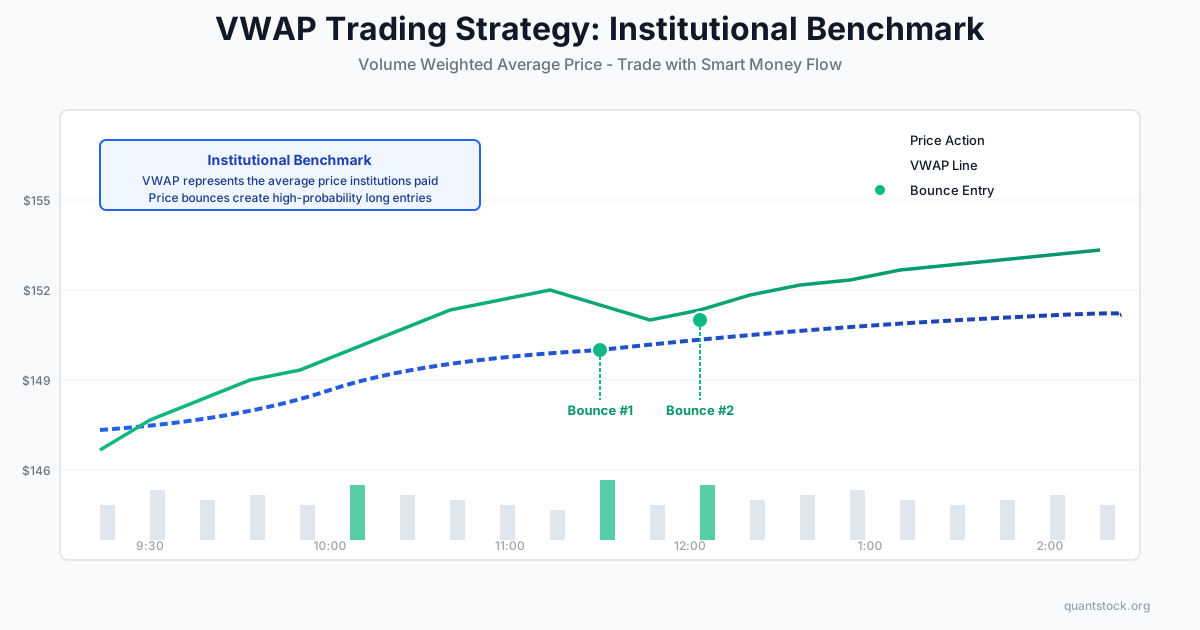
Ever wonder how institutional traders know exactly where to buy and sell? They're watching VWAP—the Volume Weighted Average Price. While retail traders chase random support levels, institutions use VWAP as their true benchmark for fair value. When price touches VWAP during a trending session, it creates high-probability bounce opportunities that professional traders exploit consistently.
In this comprehensive guide, you'll learn proven VWAP trading strategies including the VWAP bounce setup, VWAP breakout confirmation, and how to combine VWAP with price action for institutional-grade entries. Whether you're day trading stocks or scalping futures, understanding VWAP puts you on the same playing field as the smartest money in the market.
The best part? VWAP is completely objective—no subjective line drawing or lagging indicators. Just pure volume-weighted reality showing you where the majority of trading actually occurred. Let's dive into exactly how to use VWAP to improve your day trading results.
What Is VWAP and Why Do Institutions Use It?
VWAP stands for Volume Weighted Average Price, and it calculates the average price a security has traded at throughout the day, weighted by volume at each price level. Unlike a simple moving average that treats all periods equally, VWAP gives more weight to price levels where heavy volume occurred—making it a true representation of institutional activity.
Here's why VWAP matters: institutional traders use VWAP as their execution benchmark. When a large fund needs to buy 100,000 shares, their goal is to achieve an average fill price better than VWAP. If they execute at prices below VWAP, they've outperformed. If they pay above VWAP, they've underperformed. This creates natural support and resistance at the VWAP line as institutions defend their benchmark.
VWAP resets at the start of each trading session (9:30 AM EST for US stocks), making it purely an intraday indicator. The calculation accumulates volume and price data from the market open, so VWAP becomes more reliable as the session progresses and more data points are incorporated. This is why VWAP bounce setups work best after the first hour of trading when the line has established credibility.
Key Insight: VWAP acts as a dynamic support level in uptrends and dynamic resistance in downtrends. Price tends to gravitate back to VWAP like a magnet, creating predictable bounce opportunities.
The VWAP Bounce Strategy: Trading Pullbacks to Fair Value
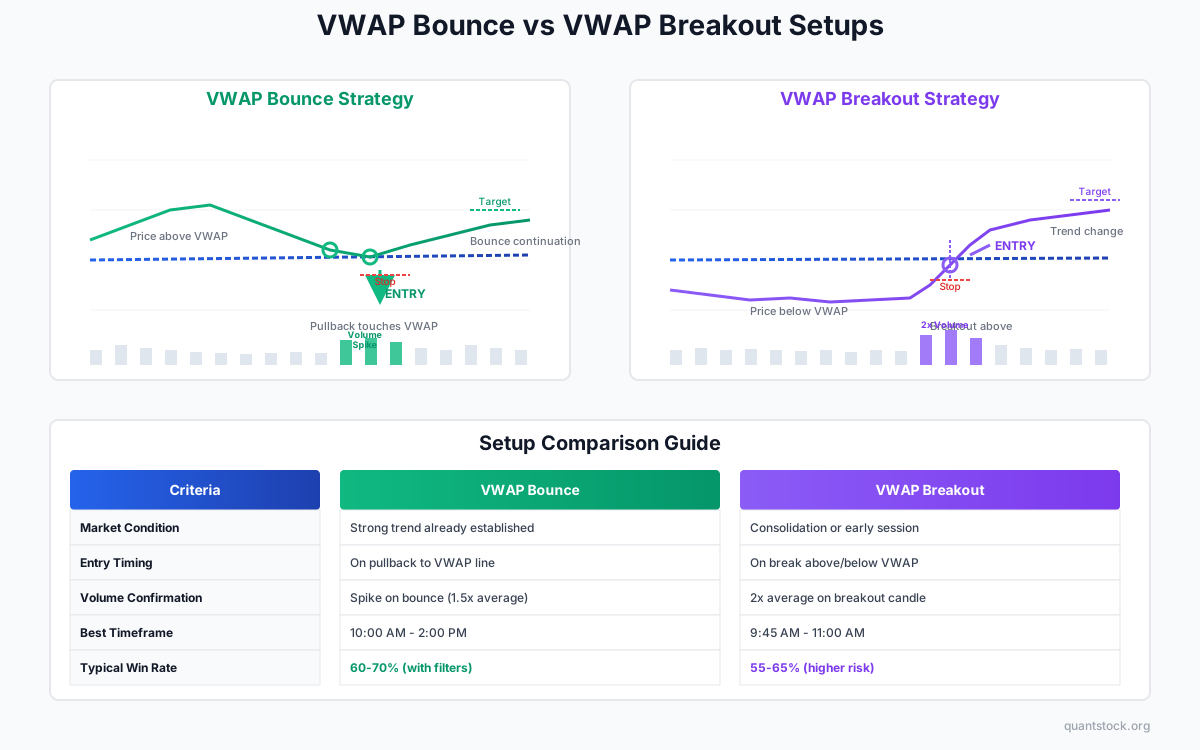
The VWAP bounce strategy is the most reliable VWAP setup for day traders. The concept is simple: when price is trending strongly above VWAP, pullbacks to the VWAP line offer low-risk entry opportunities to join the dominant trend. Institutions defend VWAP during these pullbacks, creating natural buying pressure that propels price back in the trend direction.
Setup Requirements:
- Established Trend: Price must be clearly above VWAP (for longs) or below VWAP (for shorts) for at least 30 minutes
- Clean Pullback: Price retraces to touch or slightly penetrate the VWAP line without breaking market structure
- Volume Confirmation: Decreasing volume on the pullback and increasing volume on the bounce off VWAP
- Price Action Trigger: A bullish engulfing candle, hammer, or strong rejection wick at VWAP confirms the bounce
Entry Technique: Enter on the first candle that closes back above VWAP (for longs) after the pullback touch. The ideal entry is when price bounces with a strong momentum candle and volume spike, signaling institutional buyers stepping in to defend their benchmark.
Stop Loss Placement: Place your stop 5-10 cents below the pullback low (for stocks) or below the most recent swing low. If price breaks significantly below VWAP during an uptrend, the trend is failing and you want to exit immediately. VWAP acts as your line in the sand—defending it means the trend is intact, losing it means the trend is over.
Target Setting: Target the previous swing high or use a 2:1 risk-reward ratio. Many traders scale out at 1.5R and let runners move to 3R or trail stops using VWAP itself. If price holds above VWAP for hours, each new pullback to VWAP offers another entry opportunity.
The VWAP Breakout Strategy: Confirming Trend Changes
The VWAP breakout strategy identifies when price shifts from one regime to another. A strong move above VWAP on heavy volume signals that buyers are taking control, while a breakdown below VWAP on volume indicates sellers are winning. This strategy works best in the first 1-2 hours of the trading session when initial direction is being established.
Bullish VWAP Breakout Setup:
- Price has been trading below VWAP for at least 15-30 minutes (consolidation or downtrend)
- A strong green candle breaks above VWAP with volume 1.5-2x the recent average
- Price holds above VWAP for 2-3 candles, confirming the breakout (not a fake-out)
- Enter on the first pullback to VWAP or on a breakout retest with volume
Bearish VWAP Breakdown Setup:
- Price has been trading above VWAP but shows weakening momentum
- A strong red candle breaks below VWAP with volume surge
- Price stays below VWAP, now using it as resistance
- Enter shorts on rallies back to VWAP that get rejected (VWAP becomes the ceiling)
The key difference between a real breakout and a fake-out is volume. Real institutional breakouts show 2x+ average volume because large players are establishing positions. Without volume, breakouts typically fail as there's no conviction behind the move.
Best Timeframes and Markets for VWAP Trading
VWAP is exclusively an intraday indicator, making it ideal for day traders and scalpers but completely useless for swing traders or investors. Because VWAP resets each day at market open, it only provides value during the current trading session.
Optimal Timeframes:
- 1-minute charts: For scalpers targeting quick 10-20 cent moves on high-volume stocks
- 5-minute charts: Sweet spot for most day traders—enough data to filter noise but responsive to intraday moves
- 15-minute charts: For swing traders holding positions for several hours within the day
Best Markets for VWAP:
- High-volume stocks: Stocks trading 5+ million shares daily (AAPL, TSLA, SPY, NVDA) have the most reliable VWAP due to heavy institutional participation
- Index futures: ES (S&P 500 futures) and NQ (Nasdaq futures) respect VWAP extremely well as institutions use them for hedging
- Liquid ETFs: SPY, QQQ, and sector ETFs provide clean VWAP setups with tight spreads
Avoid using VWAP on low-volume stocks (under 1 million daily volume) or during extended hours trading. Without sufficient volume, VWAP loses its meaning as an institutional benchmark since there isn't enough participation to make the volume-weighted average significant.
Combining VWAP with Other Indicators for Confirmation
While VWAP is powerful alone, combining it with complementary indicators increases win rate by filtering out low-probability setups. The goal isn't to overload your chart, but to add 1-2 confirmation tools that validate VWAP signals.
VWAP + Moving Averages: Use the 9 EMA and 20 EMA to identify the short-term trend direction. When price is above both the 9 EMA and VWAP, the trend is strongly bullish. VWAP bounces that also align with 9 EMA bounces create high-probability long entries. See our guide on EMA vs SMA crossover strategies to understand which moving average responds fastest.
VWAP + Volume Profile: Volume Profile shows you where the most volume traded across different price levels during the session. When VWAP aligns with a high-volume node from Volume Profile, that area becomes an even stronger support or resistance zone. Learn more about Volume Profile trading strategies to identify institutional accumulation zones.
VWAP + Market Structure: Always respect higher timeframe support and resistance levels. If a VWAP bounce setup occurs at a key daily support level, the confluence creates a much higher probability trade than a VWAP bounce in the middle of nowhere.
VWAP + Price Action: The best VWAP entries come from strong price action confirmation—engulfing candles, hammers, or strong rejection wicks. Don't blindly buy at VWAP; wait for price to show respect for the level with a bullish reversal pattern.
| Indicator Combination | What It Confirms | Best Use Case |
|---|---|---|
| VWAP + 9 EMA | Short-term trend direction and momentum | Scalping on 1-5 minute charts |
| VWAP + Volume Profile | High-volume accumulation zones | Day trading liquid stocks and futures |
| VWAP + Key Support/Resistance | Confluence with higher timeframe levels | Swing trades lasting several hours |
| VWAP + RSI Divergence | Reversal momentum and trend exhaustion | Catching reversals at VWAP extremes |
Common Mistakes to Avoid with VWAP Trading
- Trading Against VWAP in Strong Trends: The biggest mistake is trying to short just because price is "too far" above VWAP, or buying just because price is "too far" below VWAP. In strong trending days, price can stay on one side of VWAP for hours. Always trade WITH the side of VWAP price is on, not against it. If price is above VWAP, only look for long setups. If below VWAP, only look for short setups.
- Ignoring Volume Confirmation: VWAP without volume analysis is incomplete. A VWAP bounce on low volume is far less reliable than one with a clear volume spike showing institutional buying. Always confirm VWAP setups with volume—breakouts need 1.5-2x average volume, and bounces need increasing volume in the direction of the bounce.
- Using VWAP on Low-Volume Stocks: VWAP is an institutional tool, so it only works on instruments that institutions actually trade. If a stock is only trading 500K shares per day, there's not enough institutional participation to make VWAP meaningful. Stick to stocks with 5+ million daily volume or liquid futures contracts.
- Trading the First 15 Minutes Blindly: While the market open is exciting, VWAP needs time to establish as a credible benchmark. The first 15-30 minutes often see erratic price action that doesn't respect VWAP yet. Wait for at least 30 minutes after the open before taking VWAP bounce setups, giving the indicator time to accumulate meaningful volume data.
- Forgetting That VWAP Resets Daily: VWAP is purely intraday—it resets at market open every day. Don't carry VWAP levels from yesterday into today. Each session starts fresh, and yesterday's VWAP has zero relevance to today's trading. This also means VWAP is useless for swing trading or position trading.
Advanced VWAP Techniques: Standard Deviation Bands
Many professional traders use VWAP standard deviation bands to identify when price has moved too far from fair value. These bands plot 1, 2, and 3 standard deviations above and below the VWAP line, similar to Bollinger Bands but using volume-weighted calculations.
How to Use VWAP Bands:
- Mean Reversion Trades: When price reaches the upper 2-standard-deviation band, it's statistically expensive relative to VWAP, creating a potential fade opportunity if other factors align (like resistance levels or bearish divergence)
- Trend Continuation: In strong trends, price will "ride" the 1-standard-deviation band for extended periods. As long as price stays above the +1 SD band, the uptrend is strong
- Volatility Context: The width of the bands shows intraday volatility. Wide bands indicate choppy, volatile action where VWAP bounces are less reliable. Narrow bands suggest calmer price action where VWAP bounces work better
The 2-standard-deviation bands are particularly useful for scalpers. When price touches the upper band and shows rejection, you can take a quick short back to VWAP (the mean). When price touches the lower band and bounces, you can take a quick long back to VWAP. These are low-risk, high-probability mean reversion scalps that work best in ranging or choppy market conditions.
How to Backtest VWAP Trading Strategies
VWAP strategies require intraday data to backtest properly, which makes manual backtesting nearly impossible. You need tick-level or 1-minute bar data with volume information to calculate VWAP accurately for historical sessions. This is where systematic backtesting becomes essential.
The best way to validate any VWAP strategy is through quantitative backtesting with actual intraday data. Try our free backtesting tool to test VWAP bounce and breakout setups across historical data. You can optimize parameters like entry timing (how far from VWAP to enter), stop loss distance, and volume confirmation thresholds before risking real capital.
Key Metrics to Track When Backtesting VWAP:
- Win Rate: VWAP bounce strategies typically achieve 60-70% win rates when properly filtered
- Average Win vs Average Loss: Target at least 1.5:1 reward-risk ratio to ensure profitability even with 50% win rate
- Time in Trade: Most VWAP setups resolve within 30-90 minutes, so track holding time to optimize position sizing
- Performance by Time of Day: VWAP setups often work best 10:00-11:30 AM EST and 2:00-3:30 PM EST, avoiding the lunch chop
Don't just backtest blindly—use the data to understand WHEN your VWAP setups work best. You might discover that VWAP bounces on SPY work great from 10-11 AM but fail during lunch. Or that VWAP breakouts are more reliable in the first hour. This granular analysis separates profitable traders from those who blow up their accounts.
VWAP Trading Rules: A Complete System
Here's a complete, rules-based VWAP trading system you can implement and backtest immediately:
Long Setup Rules:
- Wait until 30 minutes after market open (10:00 AM EST for US stocks)
- Price must be above VWAP and the 9 EMA for at least 15 minutes (trending environment)
- Wait for price to pull back and touch the VWAP line
- Volume should decrease on the pullback (profit-taking, not aggressive selling)
- Enter when a bullish candle closes back above VWAP with volume 1.2x+ the 5-bar average
- Stop loss: 10 cents below VWAP or below the pullback low, whichever is closer
- Target: 2:1 reward-risk or the previous swing high
- Trail stop: Move stop to breakeven once price moves 1R in profit, then trail using VWAP
Short Setup Rules (Inverse):
- Wait until 30 minutes after market open
- Price must be below VWAP and the 9 EMA for at least 15 minutes
- Wait for price to rally and touch the VWAP line from below
- Volume should decrease on the rally (short covering, not aggressive buying)
- Enter when a bearish candle closes back below VWAP with volume confirmation
- Stop loss: 10 cents above VWAP or above the rally high
- Target: 2:1 reward-risk or the previous swing low
Risk Management Rules:
- Never risk more than 1% of account per trade
- Maximum 3 VWAP trades per session to avoid overtrading
- If stopped out twice in a row, stop trading VWAP for the day (market isn't respecting it)
- Avoid trading VWAP during major news events or FOMC announcements (erratic behavior)
Take Your VWAP Trading Further
Volume Profile Trading: Find High-Probability Entries
VWAP shows the volume-weighted average, but Volume Profile reveals exactly where the most trading occurred. Combining VWAP bounces with high-volume nodes from Volume Profile creates institutional-grade entry setups with multiple layers of confirmation.
Master Volume Profile Strategy →ATR Stop Loss: Volatility-Adjusted Exits
VWAP gives you perfect entries, but you still need optimal stop loss placement. ATR (Average True Range) calculates volatility-adjusted stops that prevent getting shaken out of good VWAP setups by normal intraday noise while still protecting your capital.
Learn ATR Stop Loss Technique →EMA vs SMA Crossover: Which Responds Faster?
Combining VWAP with moving average crossovers improves trade timing significantly. But should you use EMA or SMA? EMAs react faster to price changes, giving earlier signals that align perfectly with VWAP bounces in fast-moving day trades.
Compare EMA vs SMA Strategies →Frequently Asked Questions
What is the best timeframe for VWAP trading?
The 5-minute chart is optimal for most day traders using VWAP. It provides enough data to filter out noise while remaining responsive to intraday price action. Scalpers may prefer 1-minute charts for quicker entries and exits, while swing day traders holding positions for several hours can use 15-minute charts. VWAP is purely intraday, so timeframes above 15 minutes aren't recommended.
Does VWAP work for swing trading or only day trading?
VWAP only works for day trading because it resets at the start of each trading session. Since VWAP recalculates from scratch every morning at market open, it has no relevance for swing traders holding positions overnight. Swing traders should use traditional moving averages or pivot points instead, as these carry information across multiple days.
How do you know if a VWAP breakout is real or a fake-out?
Real VWAP breakouts require volume confirmation—look for at least 1.5-2x the average volume on the breakout candle. Additionally, price should hold on the new side of VWAP for at least 2-3 candles without immediately reversing back. If price breaks above VWAP on light volume and quickly falls back below, it's a fake-out and you should avoid the trade.
Can you combine VWAP with RSI or MACD indicators?
Yes, combining VWAP with momentum indicators like RSI improves trade filtering. For example, a VWAP bounce setup with bullish RSI divergence is much stronger than a VWAP bounce alone. Similarly, MACD crossovers that align with VWAP direction create high-conviction entries. Just avoid overloading your chart—stick to 1-2 confirmation indicators maximum.
Why do institutions use VWAP as their execution benchmark?
Institutions use VWAP as a benchmark because it represents the "fair" average price based on actual trading activity throughout the day. When a fund executes a large order, their goal is to achieve a fill price better than VWAP to prove they added value. Beating VWAP means they bought cheaper or sold higher than the average trader, demonstrating skilled execution rather than moving the market unfavorably.
Conclusion: Master VWAP to Trade Like Institutions
VWAP is one of the most powerful intraday tools available to retail traders, giving you direct insight into institutional behavior and fair value. By focusing on VWAP bounce setups in trending markets and VWAP breakouts for regime changes, you can dramatically improve your day trading consistency. The key is patience—wait for clear setups where VWAP aligns with volume confirmation and price action triggers.
Remember that VWAP isn't magic—it works because institutions actively use it as their benchmark, creating self-fulfilling prophecy as they defend the level. This makes VWAP more reliable than arbitrary support and resistance lines drawn by retail traders. You're literally following the smart money when you trade VWAP setups correctly.
Ready to test these strategies with real data? Start backtesting now and discover which VWAP approach works best for your trading style. Test different entry techniques, stop loss distances, and volume filters across thousands of trades to build a data-driven edge before risking real capital on VWAP setups.