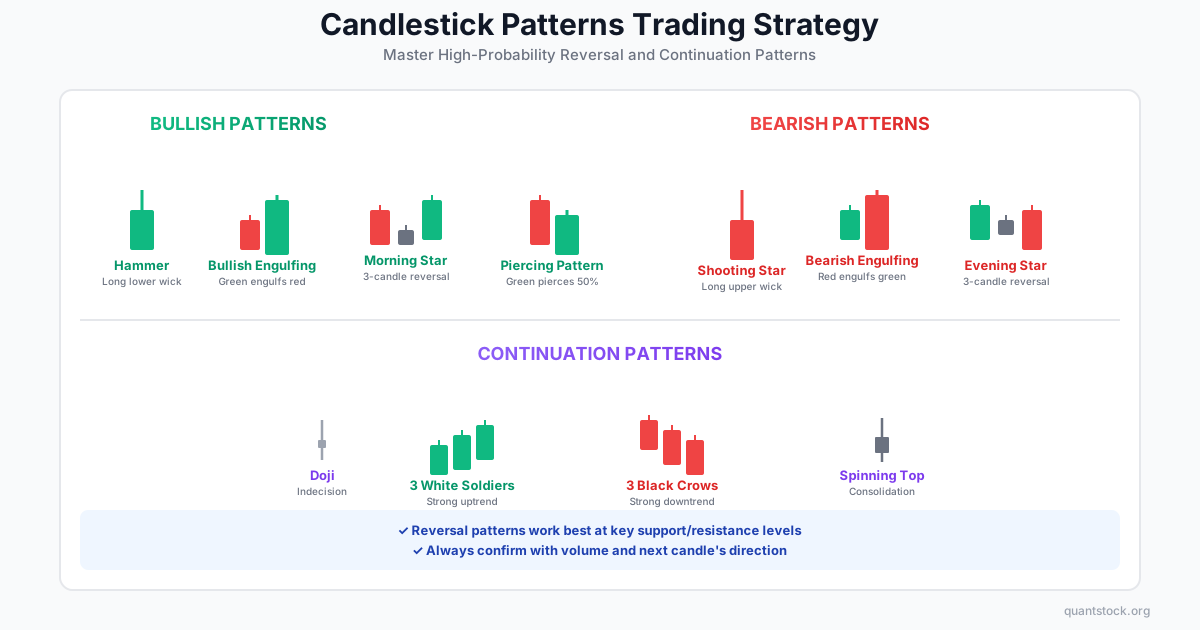
Candlestick patterns are one of the most powerful tools in a trader's arsenal, offering visual representations of market psychology and price movement. Whether you're a day trader, swing trader, or long-term investor, understanding how to identify and trade candlestick patterns can significantly improve your trading success rate. This comprehensive guide will walk you through the most reliable patterns, how to confirm them, and critical mistakes to avoid.
What Are Candlestick Patterns in Trading?
Candlestick patterns are visual formations created by the open, high, low, and close prices of a security over a specific time period. Each candlestick represents a complete trading session, whether that's a minute, hour, day, week, or month. The body of the candle shows the opening and closing prices, while the wicks (shadows) extend to show the highest and lowest prices reached during that period.
The beauty of candlestick patterns lies in their simplicity and effectiveness. They emerged from Japanese rice trading in the 17th century and have remained one of the most reliable technical analysis tools ever since. Unlike complex mathematical indicators, candlestick patterns tap into raw price action—the actual buying and selling pressure visible on every chart.
When multiple candlesticks combine to form recognizable patterns, they tell a story about market sentiment. A bullish pattern suggests that buyers are gaining control, while a bearish pattern indicates sellers are taking over. The most valuable candlestick patterns typically form at critical price levels such as support, resistance, previous highs, previous lows, and trend lines, amplifying their predictive power.
One key advantage of candlestick pattern trading is that it works across all markets—stocks, forex, cryptocurrencies, commodities, and indices. The patterns remain consistent because they're based on fundamental human psychology: fear, greed, and indecision always play out the same way in markets.
Most Reliable Bullish Candlestick Patterns
Bullish candlestick patterns signal potential upward price movements and are most effective when formed at support levels or after significant downtrends. Here are the most reliable patterns that consistently generate profitable trading signals.
Bullish Engulfing Pattern
The bullish engulfing pattern is one of the most straightforward and reliable reversal patterns. It consists of two candles: a small bearish candle followed by a larger bullish candle that completely engulfs the previous candle's body. This pattern indicates a clear shift from seller control to buyer dominance.
When a bullish engulfing forms at a support level or after a sustained downtrend, the win rate can exceed 70%. The pattern is especially powerful when the bullish candle closes well above the previous candle's open, showing strong buying pressure. Traders should wait for confirmation before entering; watching the next candle close above the pattern validates the reversal thesis.
Hammer Pattern
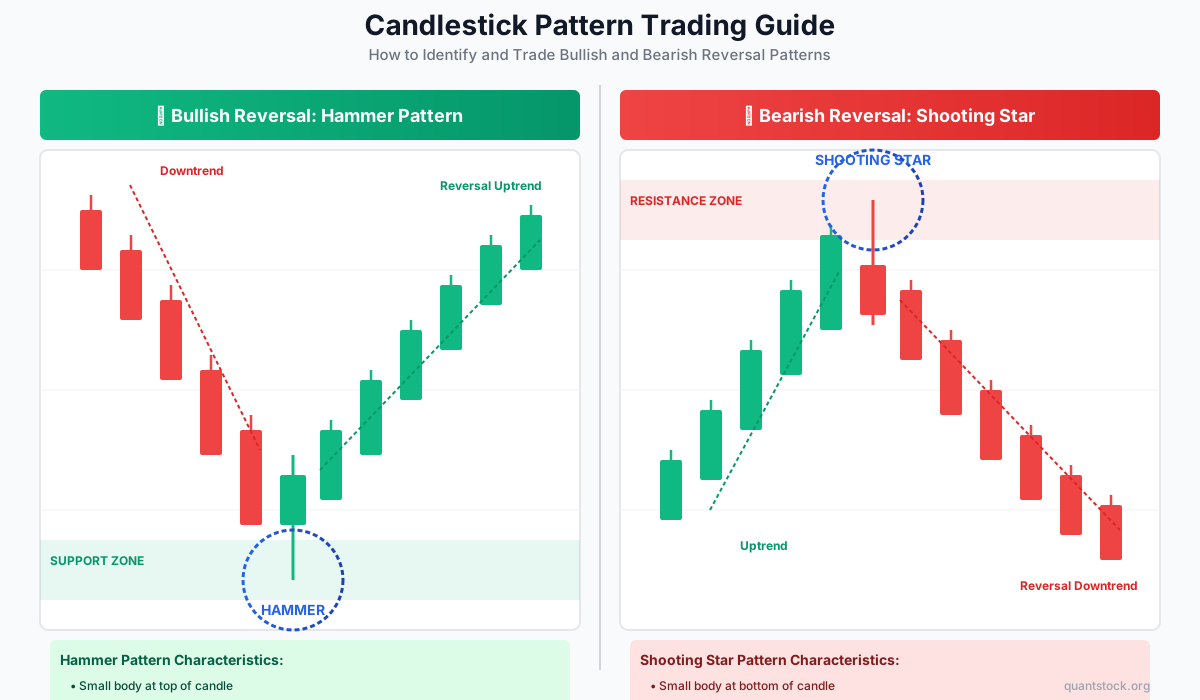
The hammer is a single-candle pattern that resembles a hammer tool with a small body and a long lower wick. This pattern forms when price is driven sharply lower during a session but buyers step in to recover most of the losses, closing near the opening price. The long wick represents the rejection of lower prices.
Hammer patterns are particularly effective at the bottom of downtrends and at key support levels. A hammer with a close above the midpoint of the candle and minimal upper wick carries more bullish weight. The pattern becomes even stronger when the following candle opens above the hammer and closes higher, confirming the reversal signal.
Morning Star Pattern
The morning star is a three-candle reversal pattern that signals a potential bottom in a downtrend. The first candle is large and bearish, the second candle is smaller with a gap down at the open, and the third candle is bullish with a gap up above the second candle's midpoint. This pattern represents the classic shift from despair (large bearish candle) to uncertainty (small candle) to hope (rising bullish candle).
Morning star patterns often appear at the conclusion of strong downtrends and can signal powerful uptrends ahead. Traders should confirm the pattern with strong volume on the third candle and wait for the bullish candle to close well above the first candle's midpoint. When this pattern forms at significant support levels, it can mark the beginning of multi-week or multi-month uptrends.
Piercing Pattern
The piercing pattern consists of two candles: a bearish candle followed by a bullish candle that opens below the previous candle's close but closes above its midpoint. This pattern shows buyers stepping in aggressively after price drops, representing a potential reversal from selling pressure to buying strength.
While not as powerful as the bullish engulfing, the piercing pattern remains effective, especially at support levels. The deeper the second candle penetrates into the first candle's body, the stronger the reversal signal. Confirmation comes from subsequent candles closing higher and ideally from volume increasing on the bullish candle.
Most Reliable Bearish Candlestick Patterns
Bearish candlestick patterns signal potential downward price movements and are most effective when formed at resistance levels or after significant uptrends. These patterns are essential for traders looking to enter short positions or exit long positions with confidence.
Bearish Engulfing Pattern
The bearish engulfing is the opposite of its bullish counterpart. It consists of a small bullish candle followed by a larger bearish candle that completely engulfs the previous body. This pattern shows a dramatic shift from buyer control to seller dominance, often signaling the end of uptrends.
When formed at resistance levels or after sustained uptrends, bearish engulfing patterns can deliver win rates exceeding 65-70%. The pattern gains strength when the bearish candle closes well below the previous open, indicating strong selling pressure. Confirmation comes from the next candle opening and closing below the pattern, validating the reversal.
Shooting Star Pattern
The shooting star is the bearish counterpart to the hammer. It features a small body with a long upper wick and minimal lower wick, resembling a star with a long tail. This pattern forms when buyers push prices higher during a session, but sellers aggressively take over, driving prices back down to close near the open.
Shooting stars are powerful reversal signals at the tops of uptrends and at resistance levels. The longer the upper wick relative to the body, the stronger the rejection of higher prices. The pattern becomes even more significant when the following candle opens below the shooting star and closes lower, confirming the bearish reversal.
Evening Star Pattern
The evening star is the bearish version of the morning star and represents a three-candle reversal pattern at the top of uptrends. The first candle is large and bullish, the second is smaller with a gap up at open, and the third is bearish with a gap down below the second candle's midpoint.
This pattern signals transition from confidence (first bullish candle) to uncertainty (small candle) to selling pressure (large bearish candle). Evening stars at significant resistance levels or after extended uptrends can mark the beginning of substantial downtrends. Strong volume on the third candle and a close well below the first candle's midpoint strengthen the pattern's reliability.
Dark Cloud Cover
The dark cloud cover consists of two candles: a bullish candle followed by a bearish candle that opens above the previous close but closes below its midpoint. This pattern shows buyers initially in control at the open, but sellers overwhelming them to close the candle deeply into the bullish candle's body.
While less powerful than bearish engulfing, dark cloud cover patterns remain effective reversal signals, particularly at resistance levels. The deeper the bearish candle penetrates into the bullish candle's body—ideally more than halfway through—the stronger the reversal signal. Confirmation comes from subsequent lower closes and ideally from increasing volume.
How to Confirm Candlestick Pattern Signals
While candlestick patterns are powerful on their own, confirmation adds significant value to your trading decisions. Entering trades based solely on pattern formation without additional confirmation can result in false signals and unnecessary losses. Here are the most effective confirmation techniques professional traders use.
Volume Analysis: The most reliable confirmation comes from volume. Bullish patterns should see increasing volume on the pattern-completing candle, showing genuine buying interest. Similarly, bearish patterns should show volume spikes on the bearish candle. Volume confirms that the pattern represents actual change in market sentiment, not just random price fluctuation.
Next Candle Confirmation: Many professional traders wait for the candle after the pattern to close favorably. For bullish patterns, this means the next candle should open and close above the pattern. For bearish patterns, the next candle should open and close below the pattern. This single additional requirement dramatically reduces false signals.
Multiple Timeframe Analysis: Check that the pattern aligns with the broader trend on higher timeframes. A hammer pattern on the 1-hour chart carries more weight if the 4-hour and daily charts are showing signs of uptrend recovery. This prevents trading counter-trend patterns that fail quickly.
Momentum Indicators: Use RSI, MACD, or stochastic oscillators to confirm direction. For bullish patterns, momentum should be rising or bottoming out. For bearish patterns, momentum should be falling or topping out. This technical confirmation validates the pattern's power.
Candlestick Patterns at Support and Resistance Levels
The location of a candlestick pattern dramatically influences its reliability. The same pattern can have vastly different win rates depending on whether it forms at a key price level or in the middle of a trading range. Professional traders understand that candlestick patterns amplify their power when they coincide with structural price levels.
Support levels represent prices where buyers have historically stepped in, preventing further declines. When a bullish candlestick pattern forms exactly at support—such as a previous low, round number, or trendline—the probability of successful reversal increases significantly. The pattern essentially shows that the support level is holding strong and buyers are ready to defend it.
Resistance levels mark prices where sellers have historically stepped in, preventing further advances. Bearish candlestick patterns at resistance become extremely powerful reversal signals. When a shooting star or dark cloud cover forms at a resistance level that has rejected price multiple times, traders can be confident that sellers will continue defending that price.
The strongest trades occur when multiple factors align: a candlestick pattern at a support or resistance level on multiple timeframes, with volume confirmation, and at a Fibonacci level or round number. This convergence of factors can deliver win rates exceeding 75-80%, making risk management and position sizing critical for protecting your capital.
However, not all support and resistance levels carry equal weight. Recent support and resistance (formed within the last few weeks) is typically stronger than older levels. Support and resistance tested multiple times carries more significance than levels tested only once. Trendline support and resistance often provides stronger reversal signals than horizontal levels.
Common Mistakes Traders Make with Candlestick Patterns
Even with a solid understanding of candlestick patterns, traders fall into predictable traps that undermine profitability. Recognizing these mistakes can prevent costly errors and accelerate your path to consistent trading success.
Trading Patterns Without Confirmation: The most common mistake is entering trades based solely on pattern formation without waiting for additional confirmation. A hammer at support becomes infinitely more reliable when the next candle closes above the hammer with volume. Patience separates successful traders from those who constantly fight false signals.
Ignoring Trend Context: Some traders trade candlestick patterns counter to the primary trend, hoping for reversals that rarely materialize. The strongest patterns work with the trend, not against it. A hammer at support in an uptrend is far more reliable than a hammer at resistance in a downtrend.
Pattern Recognition Bias: Traders often see patterns that aren't really there—perceiving random price action as meaningful formations. This confirmation bias leads to entries that fail immediately. True candlestick patterns should be obvious and clearly defined, not ambiguous.
Neglecting Position Sizing: Some traders risk the same amount on every pattern, regardless of the pattern's reliability or their account size. High-probability setups at support/resistance with multiple confirmations warrant larger positions than borderline patterns. Risk management determines long-term profitability far more than pattern accuracy.
Not Tracking Performance: Professional traders maintain detailed records of every pattern-based trade: the pattern type, timeframe, confirmations present, and the result. Without this data, you cannot identify which patterns work best in your trading style and market conditions.
Best Timeframes for Candlestick Pattern Trading
Candlestick patterns work across all timeframes, but the choice of timeframe dramatically affects holding periods, profit targets, and risk management. Understanding which timeframes suit your trading style and schedule is essential for consistent success.
Intraday Trading (1-minute to 15-minute charts): These timeframes generate frequent patterns and quick trading opportunities. Day traders and scalpers favor these charts for rapid entries and exits. However, whipsaws and false signals are more common on shorter timeframes. Success requires strict confirmation rules and tight stop-losses.
Short-Term Trading (1-hour and 4-hour charts): Most active traders find these timeframes provide an optimal balance between signal frequency and reliability. Patterns on these timeframes typically play out over hours to days, allowing room for profit-taking while keeping position holding time reasonable. Many professional traders focus primarily on these timeframes.
Swing Trading (daily charts): Daily candlestick patterns are extremely reliable because each candle represents a full day of market activity with institutional-level participation. Patterns on daily charts often indicate multi-day or multi-week moves. These timeframes suit traders with limited time availability who prefer fewer but higher-probability setups.
Position Trading (weekly and monthly charts): Patterns on these timeframes represent major market reversals and can indicate moves lasting weeks or months. These are ideal for swing traders holding positions for extended periods. However, fewer setups occur, so patience is required.
Professionals often use multiple timeframe analysis, identifying the primary trend on daily charts while using 1-hour or 4-hour charts for precise entry timing. This approach combines the reliability of longer timeframes with the frequency of shorter timeframes.
How to Backtest Candlestick Pattern Strategies
Before risking real money on any candlestick pattern strategy, backtesting is essential. Backtesting reveals which patterns work in your market conditions, optimal confirmation methods, and realistic profit expectations. The most successful traders base their strategies on data, not hope.
Define Your Strategy Rules: Start by precisely defining your pattern trading rules. Which patterns do you trade? At what price levels? What confirmations are required? What are your entry, stop-loss, and profit target rules? The more specific your rules, the more accurate your backtest results.
Gather Historical Data: Obtain historical price data for your chosen markets and timeframes. Most brokers and trading platforms provide this data. Ensure you have sufficient data—typically at least 2-3 years for reliable statistics, though more data is better.
Manual vs. Automated Backtesting: You can manually backtest by reviewing historical charts and applying your rules (tedious but educational) or use automated backtesting tools. Automated backtesting is faster but requires clear, programmable rules. Most traders combine both approaches.
Track Key Metrics: Record the win rate (percentage of trades producing profit), average win size, average loss size, profit factor (total wins / total losses), and maximum drawdown. These metrics reveal your strategy's true profitability and sustainability.
Learn more about systematic backtesting approaches in our comprehensive guides:
- Introduction to Backtesting Your Trading Strategies - Start with fundamental backtesting concepts and best practices
- Top Tools for Testing Candlestick Patterns - Explore professional-grade backtesting platforms and software
- Analyzing Your Backtest Performance Results - Understand key metrics and how to avoid overfitting
Frequently Asked Questions
What is the most reliable candlestick pattern for trading?
The bullish engulfing pattern at support levels typically delivers the highest win rates (70%+) when combined with volume confirmation. However, reliability depends on multiple factors: location relative to support/resistance, timeframe, volume confirmation, and broader trend context. Morning star and evening star patterns at key levels are equally reliable. The most reliable pattern is ultimately the one that performs best in your specific market conditions and trading style.
Can candlestick patterns work on all timeframes?
Yes, candlestick patterns work effectively across all timeframes from 1-minute to monthly charts. However, the quality of signals improves with longer timeframes. Daily and 4-hour patterns are more reliable than 5-minute patterns due to reduced noise and stronger institutional participation. Many professional traders confirm patterns across multiple timeframes: using daily charts to identify the primary trend and 1-hour or 4-hour charts for precise entry timing.
How important is confirmation when trading candlestick patterns?
Confirmation is critically important and dramatically improves win rates. Entering trades based solely on pattern formation generates many false signals. Professional traders wait for: volume confirmation on the pattern candle, favorable close of the next candle, alignment with the broader trend, and momentum indicator confirmation. Trading patterns without these confirmations is like driving with your eyes closed—mathematically possible but foolishly risky.
Why do candlestick patterns at support and resistance work better?
Support and resistance levels represent price points where institutional traders and large market participants cluster their orders. When a bullish pattern forms at support, it shows that buyers are defending a historically important price level—dramatically increasing reversal probability. The same pattern forming in the middle of a trading range lacks this institutional backing and fails more frequently. Location multiplies pattern reliability.
Should I backtest candlestick patterns before trading them?
Absolutely. Backtesting reveals which patterns actually work in your specific market conditions versus patterns you think should work. It provides hard data on win rates, average profit per trade, maximum drawdown, and profit factor. Without backtesting, you're essentially guessing. Start by defining clear rules, testing on 2-3 years of historical data, tracking key performance metrics, and only then trading patterns with positive expectancy.
Conclusion
Candlestick patterns represent one of the most accessible yet powerful tools available to traders. Unlike complex algorithms or black-box indicators, anyone can learn to identify and trade candlestick patterns effectively. The patterns covered in this guide—bullish engulfing, hammer, morning star, piercing pattern, bearish engulfing, shooting star, evening star, and dark cloud cover—have stood the test of time because they reflect fundamental market psychology.
The path to consistent profits lies not in finding the "perfect" pattern, but in mastering the fundamentals: waiting for confirmation, respecting support and resistance levels, managing risk strictly, and continuously backtesting and refining your approach. Start by focusing on one or two patterns that resonate with your trading style. Backtest them thoroughly. Define exact entry and exit rules. Trade with appropriate position sizing. Track every trade meticulously.
Over time, as you accumulate experience and data about which patterns work best in your markets, your trading accuracy will improve dramatically. The traders who succeed with candlestick patterns are not the ones who memorize dozens of formations—they're the ones who master a few patterns deeply, trade with discipline, and continuously improve through data-driven analysis.