Support & Resistance vs Trendlines: Which to Use When

Support and resistance levels are horizontal lines marking price zones where buying or selling pressure historically concentrates. Trendlines are diagonal lines connecting swing points, showing the direction and strength of a trend. Both identify where price might reverse or pause, but they work differently and excel in different market conditions.
Many traders use one or the other exclusively, missing opportunities or taking unnecessary losses. The truth is that horizontal support/resistance works best in ranging markets, while trendlines excel in trending markets. This article shows you when to use each, how to draw both correctly, and how combining them creates the highest-probability trading setups. Validate your approach with historical backtesting instead of guessing.
What Are Support and Resistance Levels?
Support is a horizontal price level where buying pressure historically overpowers selling pressure, causing price to bounce upward. Resistance is the opposite—a level where selling pressure overwhelms buyers, pushing price back down. These levels form at previous highs, lows, round numbers, or psychological price points.
Support and resistance are static—they do not move with time. A stock that found support at $50 six months ago will often respect that same $50 level in the future, even if the overall trend has changed. This memory effect occurs because traders remember these levels and place orders near them.
Key characteristics of support and resistance:
- Horizontal lines connecting multiple price touches
- Form at previous swing highs, lows, or round numbers
- Best for range-bound or sideways markets
- Static—do not adjust with new price action
- Work across all timeframes but stronger on higher timeframes
What Are Trendlines?
Trendlines are diagonal lines drawn along a series of higher lows (uptrend) or lower highs (downtrend). They show the trajectory and momentum of a trend. Unlike horizontal support and resistance, trendlines are dynamic—they adjust as new swings form, providing a moving reference for where price should find support or resistance within a trend.
A valid trendline requires at minimum three touches—two to draw the line, and a third to confirm it. The more times price respects a trendline without breaking it, the stronger that trendline becomes. When a well-established trendline finally breaks, it often signals a significant trend reversal.
Key characteristics of trendlines:
- Diagonal lines connecting swing lows (uptrend) or swing highs (downtrend)
- Dynamic—move with price action over time
- Best for trending markets with clear directional movement
- Require at least 3 touches to be valid
- Breaks signal potential trend reversals
Key Differences: Support/Resistance vs Trendlines
| Feature | Support/Resistance | Trendlines |
|---|---|---|
| Orientation | Horizontal | Diagonal |
| Movement | Static (fixed price levels) | Dynamic (moves with trend) |
| Best Market Type | Range-bound, sideways | Trending markets |
| Formation | Previous highs/lows, round numbers | Connecting swing points |
| Lifespan | Long-term (can last years) | Shorter-term (redrawn as trend evolves) |
| Break Significance | Signals breakout or breakdown | Signals trend reversal |
| Precision | Exact price level | Approximate zone (not exact) |
The fundamental difference is static vs dynamic. Support and resistance mark fixed price zones that do not change. Trendlines adjust as new data arrives, providing a moving frame of reference within a trend. Neither is better—they serve different purposes.
When to Use Horizontal Support and Resistance
Use horizontal support and resistance when the market is range-bound or consolidating. If price is moving sideways between two levels, those boundaries become your support and resistance, and trendlines are irrelevant.
Best Use Cases for Support/Resistance:
- Range trading: Buy near support, sell near resistance when price oscillates in a tight range.
- Breakout trading: When price breaks above resistance or below support, it often accelerates. These breakouts create high-probability momentum trades.
- Round number levels: Prices like $100, $50, or $1,000 act as psychological support/resistance. Institutional orders cluster at these levels.
- Previous swing highs and lows: Where price previously reversed provides strong horizontal reference points.
Example: A stock trades between $95 (support) and $105 (resistance) for three weeks. You buy at $96 when price bounces off support, sell at $104 near resistance, and repeat. The horizontal levels define the range, and trendlines offer no additional value here.
Pro Tip: Support Becomes Resistance
When price breaks through a support level, that level often becomes the new resistance. The reverse is also true—broken resistance turns into support. This role reversal creates powerful entry zones for continuation trades after breakouts.
Want Faster Entry Signals?
While support/resistance and trendlines show WHERE price will react, moving average crossovers tell you WHEN to enter. Combine EMA crossovers with your S/R levels for precise timing. Discover which moving average responds fastest in our EMA vs SMA Crossover guide.
When to Use Trendlines
Use trendlines when the market is trending—making a series of higher highs and higher lows (uptrend) or lower highs and lower lows (downtrend). Trendlines show you where the trend is likely to find support or resistance as it progresses.
Best Use Cases for Trendlines:
- Trend following: Buy pullbacks to an uptrend line, sell rallies to a downtrend line. The trendline defines "normal" retracement depth.
- Trend reversal signals: When a well-established trendline breaks, it often signals the end of the trend and a potential reversal.
- Dynamic support/resistance: In strong trends, horizontal levels may be too far away to be useful. The trendline provides a nearer, moving reference.
- Confirming trend strength: Steeper trendlines indicate stronger momentum. Flatter trendlines show weakening trends.
Example: A stock rallies from $80 to $120 over two months, making higher lows at $85, $95, and $105. You draw a trendline connecting these lows. When price pulls back to $110 and touches the trendline, you enter long with a stop below the trendline. The trendline defines dynamic support within the uptrend.
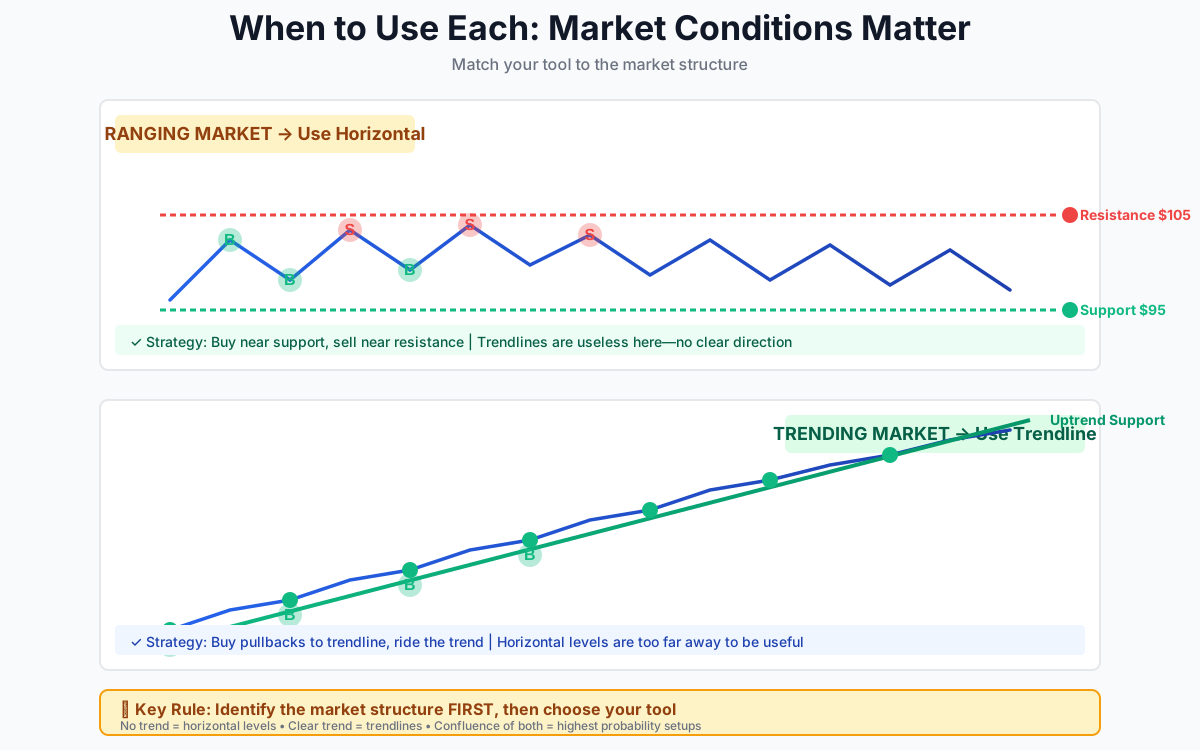
Use horizontal levels in ranges, trendlines in trends
How to Combine Support/Resistance and Trendlines
The most powerful trading setups occur when horizontal support/resistance aligns with a trendline. This confluence creates a zone with double confirmation, significantly increasing the probability of a bounce or reversal.
Strategy: Confluence Zones
Look for places where a horizontal support or resistance level intersects with a trendline. For example, an uptrend line might meet a previous resistance level that has now turned into support. This zone has two reasons to hold—the static level and the dynamic trendline—making it a high-probability entry.
Example: A stock is in an uptrend with a rising trendline. Price pulls back to $100, which coincides with both the trendline and a previous swing low from a month ago. This $100 level now has triple confirmation: historical support, current trendline support, and a round number. The odds of a bounce are significantly higher than either signal alone.
Strategy: Trend Channels
Draw parallel trendlines on both sides of the trend—one connecting lows (support trendline) and one connecting highs (resistance trendline). This creates a channel. Trade within the channel by buying near the lower trendline and selling near the upper trendline. When price breaks out of the channel, it often signals acceleration or reversal.
Strategy: Use Higher Timeframes for Confluence
Check if the support/resistance or trendline on your trading timeframe aligns with a major level on a higher timeframe. A 1-hour trendline that intersects with a daily support level is far more reliable than an isolated 1-hour signal. Always zoom out to confirm confluence with larger structures.
Common Mistakes When Drawing Support, Resistance, and Trendlines
Mistake 1: Forcing Trendlines in Ranges
Problem: Trying to draw trendlines when price is moving sideways, resulting in meaningless diagonal lines through noise.
Solution: Only draw trendlines when there is a clear trend—higher highs and higher lows, or lower highs and lower lows. If price is choppy or range-bound, use horizontal support/resistance instead. Do not force a tool where it does not belong.
Mistake 2: Drawing Lines Through Wicks Instead of Bodies
Problem: Connecting candlestick wicks (shadows) instead of closing prices, creating lines that do not reflect where price actually settled.
Solution: For support and resistance, prioritize closing prices over wicks. Wicks represent rejected prices; closes represent accepted prices. A level defined by closes is more reliable than one defined by temporary spike highs or lows. For trendlines, slight wick penetration is acceptable, but the majority of the trend should respect the line.
Mistake 3: Treating Levels as Exact Prices
Problem: Expecting price to reverse exactly at your drawn line, then abandoning the level when price breaks it by $0.10.
Solution: Think in zones, not exact prices. Support at $100 really means $99.80 to $100.20. Allow minor penetration before declaring a break. Use a buffer zone around your levels, especially on lower timeframes where noise is higher. A true break closes significantly beyond the level, not just a momentary spike.
How to Backtest Support/Resistance and Trendline Strategies
Before trading based on support, resistance, or trendlines, validate your approach with historical data. Here is how to backtest these strategies using QuantStock's backtesting tool:
Testing Horizontal Support/Resistance:
- Define support/resistance programmatically: Use pivot points, previous swing highs/lows, or round numbers (e.g., $100, $150) as fixed levels.
- Set entry rules: Enter long when price bounces within 1-2% of support; enter short when price rejects at resistance.
- Add confirmation: Require a bullish candle or RSI oversold condition at support to filter false entries.
- Measure performance: Track win rate, average profit per trade, and maximum drawdown across at least 50 trades.
Testing Trendlines:
- Identify trends algorithmically: Use moving averages (e.g., 50 EMA) or ADX to confirm trending conditions before applying trendline logic.
- Simulate trendline touches: Enter when price pulls back to a rising support line (in uptrends) or rallies to a falling resistance line (in downtrends).
- Set stop loss below/above trendline: Exit if the trendline breaks by more than 2-3%.
- Compare results: Test both support/resistance and trendline strategies on the same data to see which performs better for your target assets.
A properly backtested strategy using support, resistance, or trendlines should demonstrate consistent positive expectancy and manageable drawdowns. If results are break-even, the issue is likely poor level selection or lack of confirmation filters.
Backtest Your Support & Trendline Strategies
Test horizontal and diagonal levels with real historical data before risking capital.
Start Backtesting More StrategiesRelated Articles You'll Love
Now that you understand when to use horizontal levels versus trendlines, take your analysis to the next level with these complementary techniques:
Fibonacci Retracement Trading
Combine support/resistance with Fibonacci levels for precise entry zones. The 61.8% retracement aligned with a horizontal support level creates powerful confluence setups.
Read Full Guide →EMA vs SMA Crossover Strategy
Use moving average crossovers to confirm trend direction before trading support or trendline bounces. EMA provides faster signals while SMA filters out noise.
Compare EMA vs SMA →Frequently Asked Questions
Should I use support/resistance or trendlines for day trading?
Use both, depending on market conditions. If the intraday chart shows a clear trend (higher highs and higher lows), draw trendlines for dynamic support. If price is chopping between two levels with no clear direction, use horizontal support and resistance. The best day traders switch between both tools based on what the market is doing at that moment.
How many touches are needed to confirm a support or resistance level?
At minimum, two touches confirm a horizontal support or resistance level. Three or more touches make it significantly stronger. For trendlines, you need at least three touches—two to draw the line, and a third to validate it. The more times price respects a level or trendline without breaking, the more reliable it becomes.
What happens when both support and a trendline align at the same price?
This creates a confluence zone with double confirmation, significantly increasing the probability of a successful trade. When a horizontal level intersects with a trendline, you have both static and dynamic support or resistance working together. These setups typically offer the best risk/reward ratios and highest win rates.
Do trendlines work on all timeframes?
Yes, but they become less reliable on lower timeframes due to noise. Trendlines drawn on daily or 4-hour charts are far more dependable than those on 5-minute charts. If you day trade using trendlines, draw them on the 1-hour or 4-hour chart and use lower timeframes only for precise entry timing.
When should I redraw a trendline after it breaks?
Redraw the trendline when a new series of swing points forms, indicating a trend change. After an uptrend line breaks, wait for price to make lower highs and lower lows, then draw a new downtrend line. Do not force a trendline immediately after a break—let the new trend establish itself with at least two clear swings before drawing a new line.
Choosing the Right Tool for the Right Market
Support and resistance levels work best in range-bound, sideways markets where price oscillates between fixed boundaries. Trendlines excel in trending markets where price makes consistent higher highs and higher lows (or lower lows and lower highs). Neither tool is universally better—they serve different purposes in different conditions.
The most effective traders use both. They identify the current market structure, then apply the appropriate tool. In ranges, they trade horizontal levels. In trends, they follow trendlines. When both align, they take the highest-probability trades with confluence confirmation.
Validate your approach by backtesting both horizontal and diagonal levels on your target assets. Use QuantStock's free backtesting tool to see which approach works best for your trading style, timeframe, and market conditions.
Keep Learning: Build Your Complete System
You've mastered horizontal and diagonal levels. Now add precision with these strategies: