Price Action vs Technical Indicators: Which Trading Approach Wins?
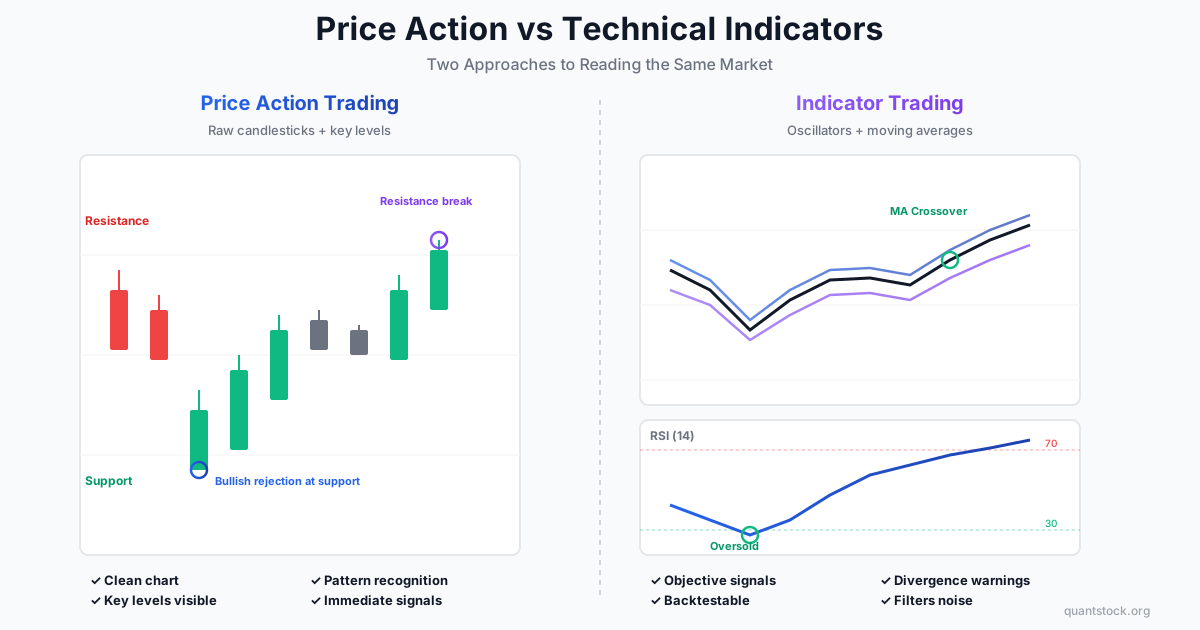
Walk into any trading forum and you'll find the same heated debate: pure price action traders swear that indicators are useless lagging tools that obscure what's really happening, while indicator traders argue that raw price analysis is subjective guesswork without quantitative confirmation. Both sides make compelling arguments, yet both are missing the bigger picture.
In this definitive comparison, you'll discover the truth behind both approaches—when price action gives you faster signals that indicators can't match, when indicators provide the objective confirmation that price action lacks, and most importantly, how the highest-performing traders combine both methods strategically rather than picking one camp and ignoring the other.
Whether you're a beginner overwhelmed by indicator choices or an experienced trader looking to refine your edge, understanding when each approach excels and when each fails will transform how you read charts and time your entries.
What Is the Difference Between Price Action and Technical Indicators?
Price action trading is the practice of making trading decisions based solely on analyzing price movements themselves—candlestick patterns, support and resistance levels, trendlines, chart patterns, and the raw behavior of price bars without any calculated overlays. Price action traders believe that all market information is already reflected in price, so adding mathematical formulas only introduces lag and complexity.
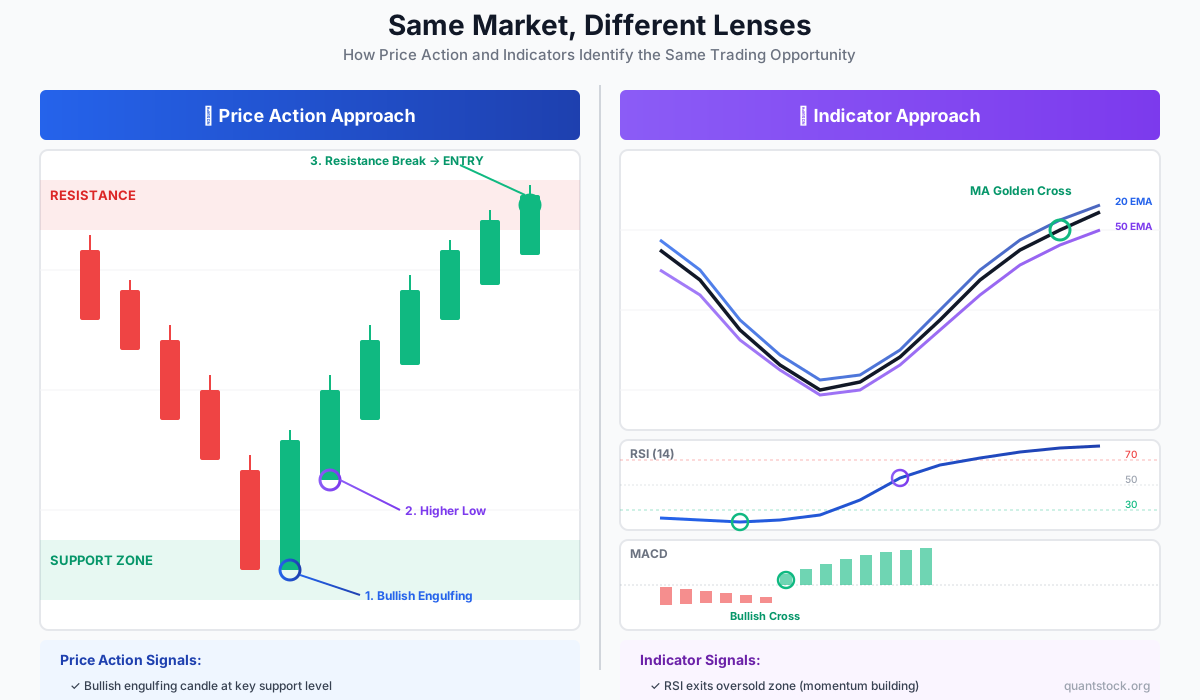
The core philosophy is straightforward: if you watch how price behaves at key levels, you can identify where institutional traders are accumulating or distributing, where stops are clustered, and where momentum is likely to accelerate or reverse. A price action trader might enter a long position simply because price formed a bullish engulfing candle at a horizontal support level that previously held multiple times—no RSI required, no moving averages needed.
Technical indicators are mathematical calculations derived from price, volume, or open interest data that aim to quantify market conditions like momentum, trend strength, volatility, or overbought/oversold levels. Common examples include RSI (Relative Strength Index), MACD (Moving Average Convergence Divergence), moving averages, Bollinger Bands, and stochastic oscillators.
The important distinction is that all technical indicators are calculated FROM price data—they're derivatives, not independent sources of information. Price action is the raw input; indicators are processed outputs. This is why indicator traders often combine multiple indicators to cross-confirm signals, while price action traders view this as adding unnecessary layers between them and the market's true message.
The Case for Price Action Trading
Price action advocates make three powerful arguments that are difficult to dismiss: indicators lag, indicators fail in choppy markets, and price tells you everything you need to know in real-time.
Indicators Lag Behind Price: Because all indicators are calculated from historical price data, they inherently lag the market. When an RSI shows "oversold," it's telling you what already happened—price already dropped significantly. By the time your moving average crossover triggers, the initial momentum burst that started the trend has often already occurred. Price action traders argue that if you're going to analyze something derived from price in order to predict where price might move next, why not just analyze raw price action in the first place?
Price Provides Context That Indicators Miss: A candlestick chart showing price rejecting a key resistance level three times with diminishing volume tells a story that no oscillator can communicate. You can see trapped buyers, exhausted momentum, and institutional distribution. Price action reveals the actual battle between buyers and sellers—who's winning, who's trapped, and where the pain points sit. Indicators reduce this rich information into a single number oscillating between arbitrary levels.
Cleaner Charts, Faster Decisions: Price action trading keeps your chart clean and your mind focused. Instead of juggling conflicting signals from RSI, MACD, and Stochastic simultaneously, you simply ask: "Is price respecting this level?" and "Is this candlestick pattern showing conviction or indecision?" This simplicity allows faster decision-making, especially crucial for day traders who need to execute quickly during volatility spikes.
The 2026 Argument: Some pure price action advocates argue that in today's algorithmic trading environment dominated by high-frequency traders and institutional algorithms, indicators have become obsolete. They claim that price action adapts instantly because it reveals what traders are willing to pay right now, while algorithms overfitted to historical indicator patterns fail when market structure changes.
The Case for Technical Indicators
Indicator proponents counter with equally compelling arguments: objectivity beats discretion, quantifiable edges can be backtested, and indicators provide early warning signals that price alone doesn't reveal until it's too late.
Indicators Remove Emotional Bias: Technical indicators provide objective, quantifiable rules that remove the discretion and subjectivity inherent in interpreting price action. What one trader sees as a "strong rejection" at resistance, another trader might view as a "consolidation before breakout." But when RSI crosses below 30, that's an objective fact every trader sees identically. This objectivity is crucial for traders who struggle with emotional discipline—your indicator doesn't care if you're scared or greedy.
Indicators Are Backtestable and Systematic: You cannot systematically backtest "trade bullish engulfing candles at support" without defining precise mathematical parameters. How large does the engulfing candle need to be? How many prior touches define "support"? How close to support is close enough? Indicators provide exact values you can code and test across thousands of historical trades. This allows you to discover genuine statistical edges rather than cherry-picking chart examples that "look good" in hindsight.
Indicators Reveal Divergences Price Doesn't Show: RSI divergence—when price makes a new high but RSI makes a lower high—warns you of momentum exhaustion before price shows obvious weakness. MACD histogram divergence catches trend weakening before the actual trendline breaks. These leading signals give you advance warning to tighten stops or prepare for reversals, information that isn't visible on a raw price chart until the reversal is already underway.
Indicators Filter Out Noise in High-Frequency Markets: While price action advocates claim indicators lag, indicator traders counter that indicators smooth out the noise and whipsaws that plague tick-by-tick price movements. In 2026's algorithmic-dominated markets where flash crashes and micro-structure noise create constant false breakouts, a 20-period moving average filters this chaos and shows you the underlying trend that matters for position trades. Sometimes lag is a feature, not a bug—it prevents you from reacting to every meaningless spike.
Price Action vs Indicators: Performance Comparison
When academic studies and trading firms compare pure price action strategies to pure indicator strategies, the results are surprisingly nuanced—neither approach dominates across all market conditions, timeframes, and asset classes.
Trending Markets: In strong trending environments, simple trend-following indicators like moving average crossovers or ADX often outperform discretionary price action because they keep you in the trend longer. Price action traders frequently exit too early when they see consolidation candles, mistaking normal pullbacks for reversals. Indicators with built-in trend filters (like MACD staying positive during an uptrend) prevent this premature exit bias.
Ranging Markets: In sideways consolidation, price action traders excel because they can visually identify horizontal support and resistance zones and trade bounces off these levels. Indicator traders suffer whipsaws as oscillators generate false breakout signals when the market chops between defined boundaries. Research shows that pure mean-reversion price action strategies (buy at support, sell at resistance) outperform indicator-based systems when ADX is below 20.
Reversal Trading: Catching major trend reversals is where the debate gets most intense. Price action traders cite chart patterns like double tops, head and shoulders, and engulfing candles as superior early reversal signals. Indicator traders counter with divergences and momentum exhaustion signals. Studies are mixed, but a 2024 research paper analyzing 50,000 reversal setups found that combining candlestick patterns with RSI divergence improved win rates by 12% compared to using either approach alone.
Timeframe Matters Significantly: On very short timeframes (1-minute, 5-minute charts), price action tends to outperform because indicator lag becomes more problematic—by the time your indicator confirms, the scalp opportunity has passed. On longer timeframes (daily, weekly), indicators provide more reliable signals because short-term noise gets smoothed out and the statistical edge becomes more robust.
When to Use Price Action vs Technical Indicators
Rather than choosing one approach and dogmatically sticking to it, successful traders switch between methods based on market context, their trading timeframe, and their personal psychology.
Use Price Action When:
- Trading very short timeframes: Scalpers and day traders on 1-minute to 15-minute charts benefit from price action's immediacy. Indicator lag matters more when you're trying to catch 10-pip moves that last minutes.
- Markets are ranging: When price is bouncing between clear horizontal levels with ADX below 20, simple support/resistance price action outperforms trend indicators that whipsaw repeatedly.
- You need to identify exact entry levels: Price action shows you the specific candle that confirmed a breakout or the exact wick that rejected resistance. Indicators give you zones and crossovers but lack the precision of "enter on the close of this engulfing candle."
- You're trading news events or volatility spikes: During earnings announcements or Fed decisions, indicators go haywire with extreme readings that become meaningless. Price action—watching how the market absorbs the news at key levels—provides more reliable signals during these periods.
Use Technical Indicators When:
- You need systematic, emotion-free rules: If you struggle with discipline or tend to talk yourself into bad trades, indicators provide objective entry and exit criteria that are harder to rationalize around.
- You're backtesting or building algorithms: Automated trading requires precise mathematical definitions. "RSI crosses above 30" can be coded and tested; "bullish price action" cannot.
- Markets are trending strongly: Trend-following indicators like moving average crossovers and ADX excel during established trends by keeping you positioned correctly and filtering out counter-trend noise.
- You trade longer timeframes: Swing traders and position traders benefit from indicators that smooth out daily noise and provide statistical confirmation of setups that might look ambiguous on raw price charts.
- You need divergence confirmation: Momentum divergences (RSI, MACD) warn of exhaustion before price structure breaks down. Pure price action won't show these leading signals until the reversal is already developing.
Combining Price Action with Technical Indicators
The most effective approach isn't choosing one method over the other—it's using indicators to filter market conditions and price action to time specific entries. This hybrid approach combines the objectivity of indicators with the precision and context of price action.
The Three-Layer Framework: Professional traders often use what's called a "top-down" approach: (1) use indicators on higher timeframes to identify the trend and market regime (trending vs ranging), (2) use price action on your trading timeframe to identify key levels and patterns, and (3) use indicators on your trading timeframe to confirm momentum and time the entry.
For example: Check the daily ADX to confirm a trend is present (ADX > 25). Drop to the 4-hour chart and identify support/resistance levels using price action. Wait for price to pull back to support and form a bullish rejection candle (price action), then confirm that RSI is above 40 and MACD is still positive (indicators). This layered approach dramatically reduces false signals.
Indicators for Filtering, Price Action for Entries: Many institutional traders use indicators exclusively for filtering out bad environments. For example: only take long trades when price is above the 200-day moving average (indicator filter), but execute actual entries based on bullish engulfing candles at prior swing lows (price action). This prevents you from fighting the trend while still getting precision entries.
Price Action for Structure, Indicators for Momentum: Use price action to map out the market structure—where are the key highs, lows, support zones, and resistance zones? These are objective facts on the chart. Then use indicators like RSI or Stochastic to gauge whether momentum supports your directional bias at these levels. If price approaches resistance but RSI shows bearish divergence, you have both structure (price action) and momentum (indicator) confirming a potential short.
Common Mistakes Traders Make in This Debate
The price action vs indicators argument often devolves into tribalism that hurts trader performance. Here are the costly mistakes both camps make:
- Treating price action as if it's not subjective: Price action traders claim their approach is "objective" because they're looking at "what actually happened," but interpretation is still required. Two traders looking at the same candlestick pattern will often disagree on whether it's bullish or bearish. At least indicators provide identical readings for all traders. Acknowledge that price action requires skill development and discretion—it's not automatically more objective just because you're not using indicators.
- Using too many conflicting indicators: Indicator traders often sabotage themselves by loading charts with RSI, MACD, Stochastic, Bollinger Bands, and three moving averages simultaneously. When these inevitably conflict (RSI says oversold while MACD says sell), they either freeze or cherry-pick the indicator supporting their bias. More indicators do not equal better signals. Stick to 2-3 complementary indicators maximum.
- Ignoring the lag vs noise tradeoff: Price action purists complain that indicators lag, but fail to acknowledge that this lag often filters out noise that would cause premature entries. Yes, a 50-period moving average lags price by 25 periods, but that's precisely why it doesn't whipsaw you with false signals every time price jitters. Lag isn't always bad—sometimes you want confirmation that a move is real before risking capital.
- Not backtesting price action setups properly: Price action traders often claim their edge but never systematically test it. They show a few cherry-picked examples of "perfect" setups that worked, ignoring the 20 similar setups that failed. If you trade price action, you must define your patterns precisely enough to backtest them, or you're just trading based on hope and selective memory.
- Assuming indicators work the same across all markets: An RSI strategy that works beautifully on forex might fail miserably on low-volume penny stocks. Indicator parameters that suit daily charts often produce garbage signals on 5-minute charts. Don't assume that because an indicator "should work in theory," it will work on your specific instrument and timeframe. Always validate with proper testing.
How to Backtest Price Action vs Indicator Strategies
The only way to definitively answer which approach works better for your trading style is systematic backtesting across hundreds of historical trades. Here's how to structure a fair comparison:
Define Your Price Action Rules Precisely: You cannot backtest vague concepts like "trade strong rejections." Define exactly what constitutes your setup: "Enter long when a bullish engulfing candle forms within 0.5% of a support level that held at least twice in the past 20 bars, with the engulfing candle's body at least 1.5x the average candle body size." Now you have something testable.
Test Both Approaches on the Same Data: Run your price action strategy and your indicator strategy on identical historical periods, instruments, and timeframes. Track win rate, profit factor, maximum drawdown, average win/loss ratio, and total return. Many traders are shocked to find their "obviously superior" method underperforms when tested objectively.
The best way to validate price action versus indicator strategies is through rigorous backtesting. Try our free backtesting tool to test candlestick patterns against RSI entries, support/resistance trades against moving average crossovers, and combined approaches against single-method strategies. You can measure which approach produces better risk-adjusted returns on your preferred instruments and timeframes.
Account for Market Regime: Don't just report overall results—break down performance by market regime (trending vs ranging, high volatility vs low volatility). You'll likely discover that price action excels in certain conditions while indicators excel in others. This insight is far more valuable than declaring one approach "better" overall. Build a regime-adaptive system that switches methods based on current market conditions.
Explore Both Approaches with These Strategies
RSI Divergence Trading Strategy
If you want to see indicator-based trading at its best, RSI divergence combines the objectivity of oscillators with the precision timing that price action traders value. Learn how momentum divergences warn of reversals before price structure breaks down, giving you the early warning that raw price action alone can't provide.
Master RSI Divergence →Support & Resistance vs Trendlines
This comparison showcases pure price action trading—identifying key levels where price has historically reversed without any indicators cluttering your chart. Discover whether horizontal support/resistance or diagonal trendlines provide more reliable entry signals and how to combine both for confluence-based trades that price action purists swear by.
Compare Price Levels →MACD vs RSI Comparison
For traders who prefer the indicator camp, this head-to-head comparison reveals when MACD's trend-following signals outperform RSI's overbought/oversold levels and vice versa. Understanding which indicator excels in which market condition helps you build a systematic, backtestable strategy rather than blindly following oscillator crossovers.
See MACD vs RSI →Frequently Asked Questions
Is price action trading more profitable than using indicators?
Neither approach is inherently more profitable—performance depends on market conditions, timeframe, and trader skill. Studies show price action excels in ranging markets and very short timeframes where indicator lag matters, while indicators outperform in trending markets and longer timeframes where statistical confirmation reduces false signals. The highest-performing traders typically combine both approaches: using indicators to filter market regime and price action to time specific entries.
Why do price action traders say indicators are useless?
Price action purists argue that all indicators are derived from price data, so analyzing indicators means analyzing a processed version of information that's already visible in raw price. They claim indicators lag the market, create false signals during choppy conditions, and add unnecessary complexity. However, this argument ignores that indicators provide objective, backtestable rules and can reveal divergences that aren't obvious on price charts alone. The "useless" claim is more ideology than fact—indicators simply serve different purposes than price action analysis.
Can you combine price action and technical indicators successfully?
Yes, combining both approaches produces superior results for most traders. Use indicators on higher timeframes to identify the trend and market regime (trending vs ranging), then use price action on your trading timeframe to identify specific entry levels like support/resistance or candlestick patterns. This hybrid approach gives you the objectivity and filtering power of indicators with the precision and context of price action. Professional traders rarely use one method exclusively—they layer both for confluence.
Which is better for beginners: price action or indicators?
Beginners typically benefit from starting with simple indicators like moving averages or RSI because they provide objective, quantifiable rules that reduce emotional decision-making. Price action requires more screen time and discretion to develop pattern recognition skills. However, beginners should learn both approaches simultaneously—understanding support/resistance levels (price action) while also using RSI for overbought/oversold confirmation (indicator) builds a more complete foundation than studying either method in isolation.
Do professional traders use price action or indicators?
Professional traders overwhelmingly use both, though the specific mix varies by trading style. Institutional algorithmic traders rely heavily on quantitative indicators because they need backtestable, systematic rules. Discretionary prop traders often emphasize price action for entries but use indicators for market regime filtering and risk management. Very few successful professional traders use exclusively one approach—the "price action vs indicators" debate is primarily an internet forum phenomenon, not a real division among consistently profitable traders.
Conclusion: The False Choice Between Price Action and Indicators
The price action versus indicators debate is a false dichotomy that costs traders money. Neither approach is universally superior—they excel in different conditions, serve different purposes, and complement each other when used strategically. Price action provides context, precision, and immediate market information. Indicators provide objectivity, statistical confirmation, and systematic filtering.
The real question isn't "which is better?" but rather "when do I use each approach?" Use indicators to identify market regime and filter out bad trading environments. Use price action to time specific entries at key levels with precision. Combine both for confluence when high-probability setups appear. Stop viewing trading as a religious war between camps and start viewing it as a toolbox where different tools serve different functions.
Ready to test which approach works best for your trading style? Start backtesting now and compare pure price action setups against indicator-based strategies against hybrid approaches. Measure the results objectively across hundreds of trades, and let the data—not internet arguments—guide your strategy development.