EMA vs SMA Crossover: Which Moving Average Works Best
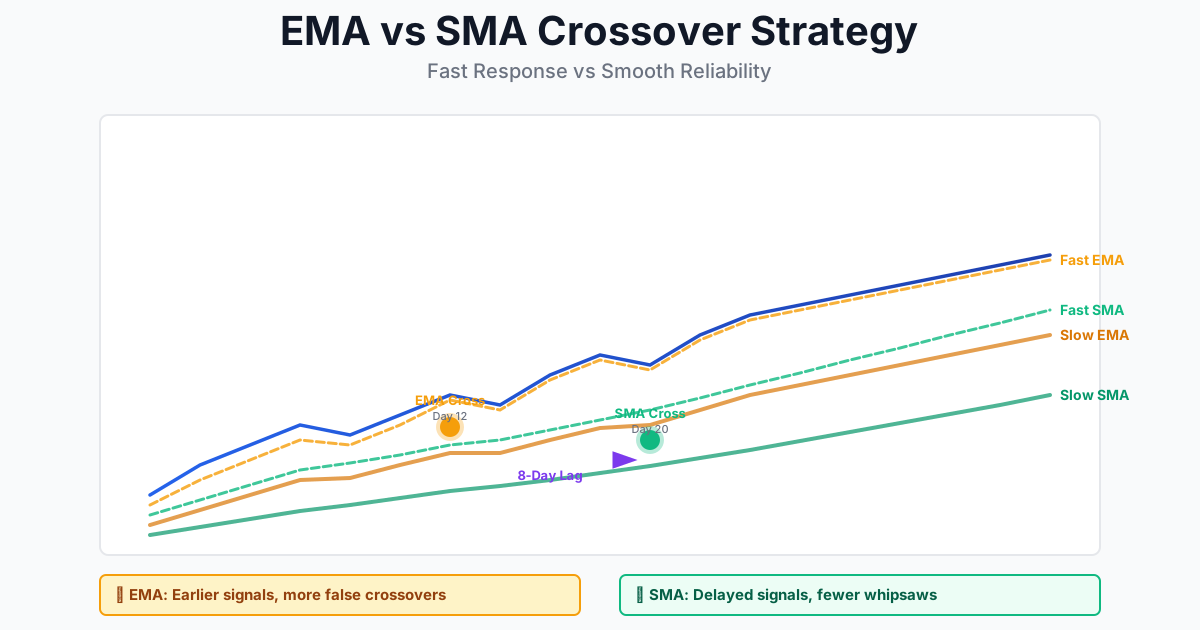
Moving average crossovers generate buy and sell signals when a fast moving average crosses above or below a slow moving average. The crossover itself is simple—the question is whether to use Exponential Moving Averages (EMA) or Simple Moving Averages (SMA). Each responds differently to price changes, producing different entry timing, signal frequency, and false signal rates.
EMA gives more weight to recent prices, reacting faster but generating more false signals in choppy markets. SMA weights all prices equally, producing smoother signals with more lag but fewer whipsaws. This article shows you when each works best, how to combine them, and how to validate your crossover strategy with historical backtesting data instead of guessing.
What Is a Simple Moving Average (SMA)?
A Simple Moving Average (SMA) calculates the average price over a specified number of periods, giving equal weight to every price point. A 20-period SMA adds up the last 20 closing prices and divides by 20. As new data arrives, the oldest price drops off and the newest is added.
The SMA is the baseline moving average—straightforward, unbiased, and easy to understand. It smooths out price noise by treating all recent prices as equally important. This equal weighting creates a lagging indicator that changes slowly, making it reliable for identifying established trends but slow to react to sudden price changes.
Key characteristics of SMA:
- All prices in the period weighted equally
- Slower to respond to recent price changes
- Produces smoother lines with less noise
- Better for confirming long-term trends
- Fewer false signals in choppy markets
What Is an Exponential Moving Average (EMA)?
An Exponential Moving Average (EMA) gives more weight to recent prices and less weight to older prices, using an exponential smoothing formula. A 20-period EMA reacts faster to the last few price bars than a 20-period SMA, which treats all 20 bars equally.
The EMA's exponential weighting makes it more responsive to new information. When price changes direction, the EMA adjusts faster than the SMA, producing earlier crossover signals. This speed advantage helps catch trend changes sooner but also generates more false signals when price oscillates without a clear trend.
Key characteristics of EMA:
- Recent prices weighted more heavily
- Faster to respond to price changes
- Earlier entry and exit signals
- Better for short-term and day trading
- More false signals in sideways markets
EMA vs SMA: Key Differences
| Feature | SMA (Simple) | EMA (Exponential) |
|---|---|---|
| Weighting | All prices equal | Recent prices weighted more |
| Response Speed | Slower, more lag | Faster, less lag |
| Smoothness | Smoother, less volatile | More reactive, closer to price |
| False Signals | Fewer whipsaws | More false crossovers |
| Best Timeframe | Long-term, swing trading | Short-term, day trading |
| Trend Confirmation | Stronger for established trends | Earlier entry, earlier exit |
| Market Type | Better in trending markets | Better in volatile/fast markets |
The core difference is lag vs noise. SMA has more lag but filters out more noise. EMA has less lag but includes more noise. Neither is universally better—the right choice depends on your trading timeframe, the market's volatility, and your tolerance for false signals.
Moving Average Crossover Strategy Basics
A crossover strategy uses two moving averages: a fast MA (shorter period) and a slow MA (longer period). When the fast MA crosses above the slow MA, it signals a potential uptrend (buy signal). When the fast MA crosses below the slow MA, it signals a potential downtrend (sell signal).
Popular Crossover Combinations:
- Golden Cross (Death Cross): 50-day SMA crosses 200-day SMA (long-term trend change)
- Day Trading: 9 EMA crosses 21 EMA (fast entries and exits)
- Swing Trading: 12 EMA crosses 26 EMA (MACD signal line equivalent)
- Trend Following: 20 SMA crosses 50 SMA (medium-term trend capture)
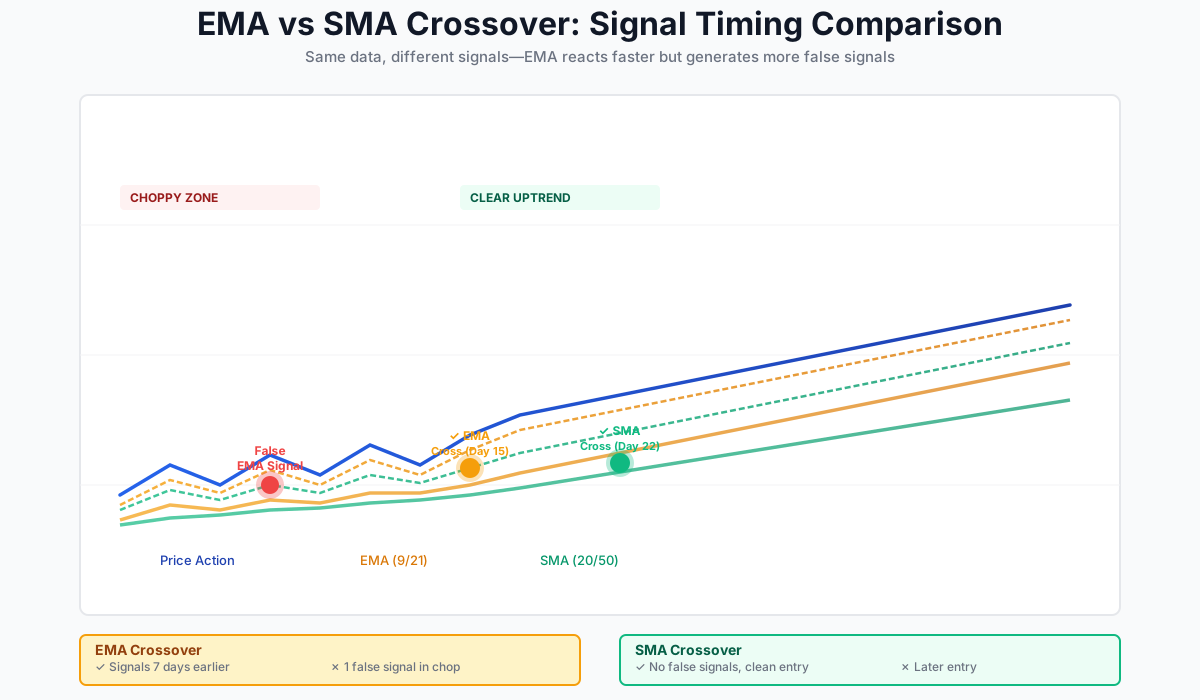
EMA crossovers signal earlier but produce more false signals in choppy markets
BUY SIGNAL: Fast MA crosses above Slow MA
SELL SIGNAL: Fast MA crosses below Slow MA
When to Use EMA Crossovers
Use EMA crossovers when you need faster entry signals and are willing to tolerate more false signals in exchange for earlier positioning. EMA crossovers work best in these scenarios:
1. Day Trading and Scalping
Day traders need fast signals to catch intraday momentum. A 9 EMA / 21 EMA crossover on a 5-minute or 15-minute chart reacts quickly to short-term price changes. The lag from SMA would cause you to miss entries or get stopped out more frequently on fast-moving intraday setups.
2. Volatile Markets
In fast-moving, volatile markets like crypto or small-cap stocks, waiting for SMA confirmation means missing significant moves. EMA's faster response helps you enter sooner during explosive trends, even if it means accepting occasional false starts.
3. Momentum Trading
Momentum traders want to catch the beginning of strong moves. EMA crossovers signal earlier than SMA, allowing entry closer to the start of the momentum surge. You enter faster but must use tighter stops to manage the increased false signal rate.
4. Combining with Other Indicators
EMA crossovers work well when combined with RSI, MACD, or volume filters. The EMA provides the entry signal, while the secondary indicator filters out low-probability setups. This combination reduces the false signal problem while maintaining EMA's speed advantage.
When to Use SMA Crossovers
Use SMA crossovers when you want fewer false signals and are comfortable with delayed entries in exchange for higher reliability. SMA crossovers excel in these situations:
1. Swing Trading and Position Trading
Swing traders hold positions for days or weeks and do not need fast entries. A 20 SMA / 50 SMA crossover on a daily chart provides reliable trend confirmation without the whipsaws that plague EMA crossovers during consolidation. You enter later but with higher confidence that the trend is real.
2. Choppy, Range-Bound Markets
In sideways markets, EMA crossovers produce constant buy and sell signals as price oscillates, resulting in repeated losses from whipsaws. SMA's smoother response filters out much of this noise, keeping you out of low-probability trades until a real trend emerges.
3. Long-Term Trend Following
The famous Golden Cross (50 SMA crossing 200 SMA) uses SMA specifically because it confirms major trend changes, not minor fluctuations. Institutional investors and long-term traders prefer SMA for its stability and resistance to short-term noise.
4. Beginner Traders
New traders often struggle with the psychological pressure of frequent false signals. SMA crossovers generate fewer trades, making them easier to follow and less emotionally taxing. You spend less time second-guessing signals and more time learning proper risk management.
Pro Tip: Use EMA for Entry, SMA for Trend Filter
Many professional traders combine both: use a long-term SMA (like 200 SMA) to define the overall trend direction, then take EMA crossover signals only in the direction of the SMA trend. This hybrid approach gives you EMA's speed with SMA's reliability.
Need Precise Entry Zones for Your MA Crossovers?
Moving averages tell you the trend direction, but where exactly should you enter during a pullback? Fibonacci retracement levels pinpoint precise entry zones within the trend. When a Fibonacci level aligns with your EMA crossover, you have a high-probability setup. Learn the exact levels that work best in our Fibonacci Retracement Trading guide.
Common Moving Average Crossover Mistakes
Mistake 1: Trading Crossovers Without Trend Confirmation
Problem: Taking every crossover signal regardless of the larger trend, leading to losses during sideways consolidation.
Solution: Only trade crossover signals in the direction of the higher timeframe trend. If the daily chart shows an uptrend, only take bullish crossovers on the hourly chart. This single filter can eliminate 60%+ of false signals according to backtesting studies.
Mistake 2: Using Crossovers Alone Without Additional Filters
Problem: Relying solely on MA crossovers without volume, RSI, or other confirmation, resulting in too many losing trades.
Solution: Add at least one confirmation filter. Require RSI to be below 40 for bullish crossovers (oversold) or above 60 for bearish crossovers (overbought). Or require volume to be above average. Research shows unfiltered crossovers produce 35-40% win rates; adding filters can push win rates to 55-60%.
Mistake 3: Choosing the Wrong MA Periods for Your Timeframe
Problem: Using day trading EMA periods (9/21) on daily charts or swing trading SMA periods (50/200) on 5-minute charts.
Solution: Match your MA periods to your holding time. Day traders: 9/21 EMA. Swing traders: 12/26 EMA or 20/50 SMA. Position traders: 50/200 SMA. Using periods designed for a different timeframe guarantees poor results. Always backtest your chosen periods before trading them.
How to Backtest EMA vs SMA Crossover Strategies
Before trading any crossover strategy, validate it with historical data. Here is how to backtest EMA vs SMA crossovers using QuantStock's backtesting tool:
Step 1: Define Your Crossover Pairs
Choose the specific periods for your fast and slow moving averages. For EMA, start with 9/21 or 12/26. For SMA, test 20/50 or 50/200. Run the same strategy with both EMA and SMA to directly compare performance.
Step 2: Set Entry and Exit Rules
Entry: Buy when fast MA crosses above slow MA. Sell (or short) when fast MA
crosses below slow MA.
Exit: Exit on the opposite crossover, or add a stop loss at a fixed percentage
or ATR multiple.
Step 3: Add Filters to Reduce False Signals
Test your baseline strategy, then add one filter at a time to measure improvement:
- Trend Filter: Only take signals in the direction of the 200-day SMA
- RSI Filter: Require RSI < 40 for buys, RSI > 60 for sells
- Volume Filter: Require volume above 20-day average on crossover day
- ADX Filter: Only trade when ADX > 25 (trending conditions)
Step 4: Compare EMA vs SMA Results
Run the same strategy with both EMA and SMA periods. Compare:
- Win Rate: Percentage of profitable trades
- Average Win/Loss Ratio: Size of wins vs losses
- Maximum Drawdown: Worst peak-to-trough decline
- Total Return: Final equity after all trades
- Number of Trades: How many signals were generated
Step 5: Test Across Multiple Assets and Timeframes
Do not rely on results from one stock or one time period. Test across at least 10-20 different assets over 2+ years to ensure your edge is real, not random luck. If EMA performs better on volatile tech stocks but SMA performs better on stable blue chips, tailor your approach accordingly.
A properly backtested crossover strategy should show positive expectancy with manageable drawdowns. If your results are break-even or worse, the issue is likely lack of filters, wrong MA periods for your timeframe, or trading in markets where crossovers do not work (choppy, range-bound).
Backtest Your Moving Average Strategy Now
Compare EMA vs SMA crossovers with real historical data and find which works best for you.
Start Backtesting More StrategiesSupercharge Your MA Strategy with These Techniques
Moving average crossovers provide entry timing, but combining them with other tools dramatically improves your win rate. Explore these complementary strategies:
Fibonacci Retracement Trading
Use Fibonacci levels to identify precise entry zones during MA crossover pullbacks. When the 61.8% retracement aligns with your EMA, you have double confirmation.
Learn Fibonacci Entries →Support & Resistance vs Trendlines
Confirm your MA crossover signals with support/resistance zones. Buy EMA crossovers that occur at strong horizontal support for the highest probability trades.
Master S/R Levels →Frequently Asked Questions
Is EMA or SMA better for day trading?
EMA is generally better for day trading because it reacts faster to recent price changes, giving you earlier entry and exit signals. Day traders need speed to catch intraday momentum, and EMA's reduced lag provides that advantage. Use 9 EMA / 21 EMA on 5-minute or 15-minute charts for day trading. Just be aware that faster signals mean more false signals, so add volume or RSI filters to improve accuracy.
Which moving average crossover is most reliable?
The 50 SMA / 200 SMA crossover (Golden Cross / Death Cross) is considered the most reliable for long-term trend changes because it uses SMA's smoothness to filter out short-term noise. However, reliability comes at the cost of late entries—this crossover signals well after the trend has started. For swing trading, the 12 EMA / 26 EMA crossover offers a better balance of speed and reliability. No crossover is universally reliable—always add confirmation filters.
Can I use EMA and SMA together in the same strategy?
Yes, and many professional traders do exactly this. A common approach: use a long-term SMA (like 200 SMA) to define the overall trend, then trade shorter-term EMA crossovers (9 EMA / 21 EMA) only in the direction of the SMA trend. This hybrid strategy gives you EMA's faster entries with SMA's trend-filtering reliability, significantly reducing false signals.
How do I reduce false signals from moving average crossovers?
Add confirmation filters. The most effective are: (1) Only trade crossovers in the direction of the higher timeframe trend, (2) Require RSI to be oversold (<40) for bullish crossovers or overbought (>60) for bearish crossovers, (3) Require volume to be above average on the crossover day, (4) Use ADX to confirm trending conditions (ADX > 25). Research shows unfiltered crossovers produce 35-40% win rates; adding these filters can push win rates to 55-60%.
What are the best EMA settings for swing trading?
For swing trading, the 12 EMA / 26 EMA combination is popular because it mirrors the MACD signal line logic and provides a good balance of responsiveness and reliability. Alternatively, use 20 EMA / 50 EMA for slightly smoother signals with fewer whipsaws. Always match your EMA periods to your intended holding time—if you hold positions for 5-10 days, use daily charts with these periods. Test both combinations on your target stocks before committing.
Choosing Between EMA and SMA for Crossover Strategies
EMA crossovers generate earlier signals and work best for short-term trading, day trading, and volatile markets where speed matters. SMA crossovers generate fewer false signals and work best for swing trading, position trading, and choppy markets where reliability outweighs speed.
Neither is universally better. The right choice depends on your trading timeframe, risk tolerance, and the market conditions you face. Day traders benefit from EMA's speed. Swing traders benefit from SMA's stability. Many successful traders use both—SMA to define the trend, EMA to time entries.
Validate your approach with historical data before risking capital. Use QuantStock's free backtesting tool to compare EMA vs SMA crossovers on your target assets and timeframes, and discover which moving average strategy fits your trading style best.
Next Steps: Complete Your Trading Toolkit
Moving averages are just one piece of the puzzle. Add these powerful techniques: