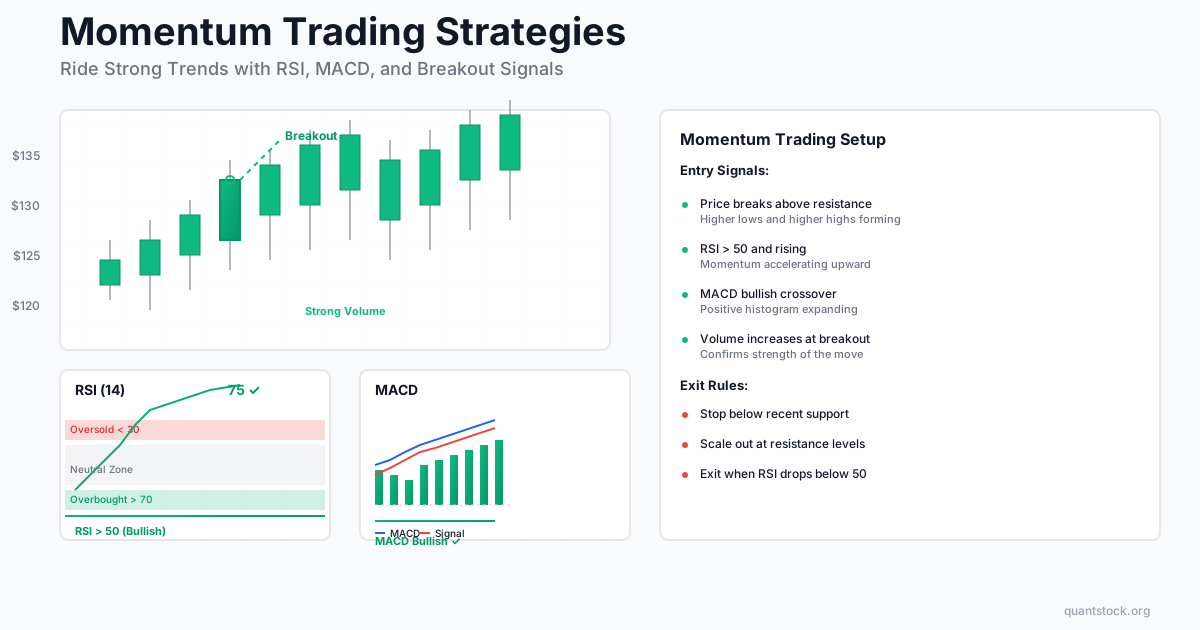
Momentum trading is one of the most popular and effective trading strategies for capturing large price moves in financial markets. Unlike mean reversion strategies that bet on prices returning to average levels, momentum trading seeks to profit from strong, directional price movements that continue in their current direction. This comprehensive guide will walk you through the best momentum trading strategies, the most reliable indicators, and practical techniques to maximize your trading results while avoiding common pitfalls.
What Is Momentum Trading?
Momentum trading is a strategy based on the principle that assets with strong price movement in one direction tend to continue moving in that same direction, at least in the short to medium term. Rather than predicting where a price will go, momentum traders follow where it's already going, riding the wave of existing trends created by market sentiment, news events, or institutional buying/selling pressure.
The core philosophy of momentum trading differs fundamentally from mean reversion. While mean reversion traders look for overbought or oversold conditions expecting prices to bounce back, momentum traders view these same conditions as confirmation that a strong trend is in place. When an asset shows strong momentum, momentum traders want to enter the trade and hold for as long as the momentum persists.
Momentum can be measured in several ways: price action patterns, volume analysis, moving average positioning, and momentum oscillators. Successful momentum traders develop a systematic approach to identifying when momentum is building, when to enter trades, and most importantly, when momentum is fading and it's time to exit. The timeframe for momentum trades can range from minutes to weeks, depending on the trading style and market conditions being exploited.
Best Momentum Indicators for Trading
Understanding and effectively using momentum indicators is essential for any momentum trader. These tools quantify momentum and help confirm whether price moves are backed by sufficient buying or selling pressure. The following are the most reliable momentum indicators used by professional traders:
Relative Strength Index (RSI)
The RSI measures momentum by comparing average gains and losses over a specified period (typically 14). It ranges from 0 to 100, with readings above 70 indicating overbought conditions and readings below 30 indicating oversold conditions. Momentum traders use RSI differently than mean reversion traders—instead of shorting overbought conditions, momentum traders view RSI above 70 as confirmation that strong upward momentum exists and that buying should continue.
MACD (Moving Average Convergence Divergence)
MACD is one of the most versatile momentum indicators. It consists of two exponential moving averages (the MACD line and signal line) and a histogram showing the difference between them. When the MACD line crosses above the signal line, it generates a bullish momentum signal. The MACD histogram expanding indicates strengthening momentum, while a contracting histogram suggests momentum is weakening. MACD is particularly useful for identifying trend changes and measuring momentum strength.
Average Directional Index (ADX)
ADX quantifies trend strength on a scale of 0 to 100, without indicating direction. An ADX reading above 25 indicates a strong trend with sufficient momentum, while readings below 20 suggest a weak trend. Momentum traders use ADX to confirm that a market has momentum worth trading. Many professional momentum traders only take setups when ADX is above 25, ensuring they're trading in strong trending conditions.
Stochastic Oscillator
The Stochastic Oscillator compares a closing price to a price range over a specific period. Like RSI, it ranges from 0 to 100, with readings above 80 indicating overbought and below 20 indicating oversold. For momentum trading, a Stochastic reading above 80 in an uptrend can confirm that momentum is strong and buying should continue. The indicator is particularly useful for timing entry points within ongoing trends.
Momentum Breakout Trading Strategy
The momentum breakout strategy is one of the most straightforward and effective momentum trading approaches. It involves identifying resistance or support levels and entering trades when price breaks through these levels with strong volume confirmation.
How the Strategy Works:
- Identify Key Levels: Look for previous highs (resistance) or previous lows (support) that represent areas where price has struggled in the past.
- Monitor Volume Confirmation: The most critical component of a valid breakout is volume. As price approaches the resistance or support level, keep an eye on volume levels. A breakout requires above-average volume to confirm that momentum is real.
- Enter on the Breakout: Place a buy order above resistance (for long trades) or a sell order below support (for short trades). Many traders set their entry just above the resistance level to avoid false breakouts.
- Set Stop Loss: Always place a stop loss just below the broken support level (for long trades) or just above the broken resistance level (for short trades).
- Trail Your Profits: As the trade moves in your favor, use a trailing stop loss to protect profits while allowing for continued upside potential.
The key to successful breakout trading is volume confirmation. A breakout without volume is likely a false breakout that will quickly reverse. Professional traders only take breakouts when volume is significantly above the 20-day average, ensuring institutional participation is backing the move.
Momentum Pullback Trading Strategy
While momentum breakout trading catches the initial impulse of a trend, the momentum pullback strategy is designed to capitalize on temporary retracements within strong trends. This strategy recognizes that strong trends don't move in a straight line—they often pull back slightly before resuming their direction.
How the Strategy Works:
- Confirm the Trend: Use ADX or moving averages to confirm that a strong trend is in place. The 50-period and 200-period moving averages can help identify the trend direction.
- Wait for the Pullback: After a strong uptrend move, prices will often pull back to a moving average or a Fibonacci retracement level (typically the 38.2% level). This pullback is where momentum traders enter.
- Enter on Confirmation: Enter the trade when price bounces from the pullback level (support) with fresh momentum confirmation signals from RSI or MACD crossing above their signal lines.
- Use Tight Stops: Place a stop loss just below the pullback level, as a break below it suggests the trend has ended.
- Take Profits at Resistance: Set profit targets at previous highs or resistance levels where the trend is likely to face temporary obstacles.
The pullback strategy is particularly effective in swing trading timeframes (4-hour and daily charts). It provides better risk-to-reward ratios than breakout trading because you're entering closer to dynamic support levels rather than chasing price at new extremes.
Combining Momentum Indicators for Confirmation
Professional momentum traders never rely on a single indicator. Instead, they use multiple indicators to confirm momentum signals and increase the probability of successful trades. Using indicator combinations reduces false signals and helps traders distinguish between real momentum and temporary price spikes.
ADX + RSI Combination:
This powerful combination uses ADX to confirm trend strength and RSI to confirm overbought conditions that reinforce momentum. A valid signal occurs when ADX is above 25 (confirming a strong trend) and RSI is above 70 (confirming strong momentum buying). This combination is particularly effective for identifying the beginning stages of new trends where momentum is accelerating.
MACD + Stochastic Combination:
MACD provides long-term momentum confirmation through its moving average crossovers, while the Stochastic Oscillator provides more precise entry timing within those trends. A valid signal occurs when MACD lines cross above the signal line (bullish momentum) and the Stochastic Oscillator rises above 50, indicating continued upward momentum. This combination is excellent for both intraday and swing trading.
The Momentum Confluence Approach:
The most robust momentum trading approach uses price action combined with multiple indicator confirmations. Look for setups where breakouts occur on high volume, ADX is above 25, RSI is above 50 (in uptrends) or below 50 (in downtrends), and MACD is trending in the direction of the trade. When all these elements align—what traders call "confluence"—the probability of a successful momentum trade increases significantly.
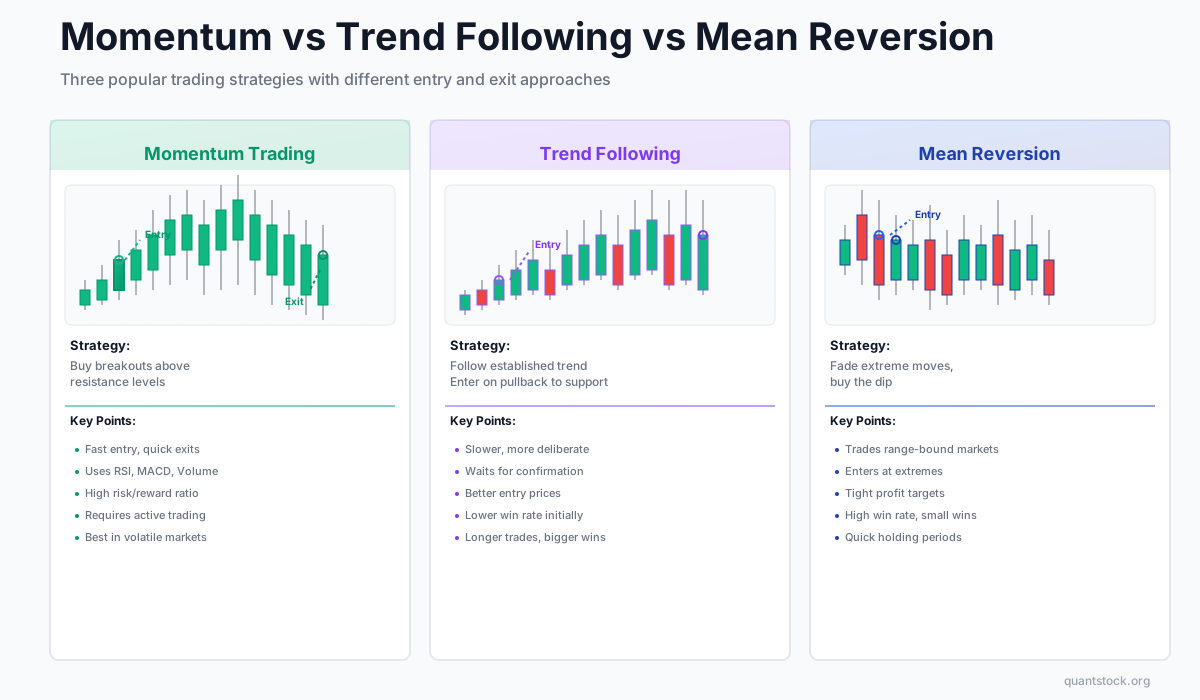
Momentum Trading vs Trend Following vs Mean Reversion
Understanding how momentum trading differs from other major trading philosophies helps traders choose the approach that best fits their trading style and market outlook. These three strategies often seem similar but have fundamental differences in execution and market philosophy.
| Aspect | Momentum Trading | Trend Following | Mean Reversion |
|---|---|---|---|
| Core Philosophy | Prices in motion stay in motion; ride strong directional moves | Follow established trends without predicting reversals | Prices revert to average; profit from extreme moves |
| Entry Signal | Breakouts, overbought conditions, volume spikes | Price crossing above moving averages, trend line breaks | Overbought/oversold indicators, extreme price levels |
| Exit Strategy | Trailing stops, momentum fading indicators, resistance levels | Trend line breaks, moving average crossovers | Price returns to mean, stop loss hits predetermined levels |
| Timeframe | Intraday to swing (minutes to weeks) | Swing to position trading (days to months) | Intraday to swing (minutes to days) |
| Risk Profile | Medium risk; requires tight stop management | Lower risk; follows established patterns | Higher risk; fights strong trends initially |
| Market Environment | Trending markets (ADX > 25) | Trending markets with established patterns | Range-bound, choppy markets |
Common Mistakes in Momentum Trading
Even traders who understand momentum concepts make preventable mistakes that cost them money. Learning from these common errors will help you avoid the pitfalls that derail many momentum traders:
1. Chasing Price Without Confirmation
The biggest mistake momentum traders make is entering trades late in a move without proper indicator confirmation. Just because a stock has moved up 20% doesn't mean you should chase it into exhaustion. Always wait for proper confirmation signals from at least two indicators before entering. The best trades often occur early in moves when confirmation is clearest, not at the end when price has already extended.
2. Ignoring Volume Confirmation
A price move without volume is like a building without a foundation. Many momentum breakouts fail because they lack volume confirmation. Professional traders use volume as a gating mechanism—if volume isn't above average, the setup is rejected regardless of other signals. High volume breakouts have roughly 70% success rates, while low-volume breakouts fail more than 50% of the time.
3. Trading Without Stop Losses
Every momentum trade needs a defined stop loss. The market will eventually test your thesis, and without a stop loss, a small loss becomes a catastrophic one. Place stops logically based on technical levels—just below support for long trades or just above resistance for short trades. A well-placed stop loss should not be wider than your profit target, ideally maintaining at least a 2:1 reward-to-risk ratio.
4. Using Wrong Timeframes for Your Strategy
Momentum trading works best in medium timeframes where momentum signals are reliable and noise is filtered out. Trading 1-minute momentum breakouts is extremely challenging due to noise and slippage. Similarly, trying to trade daily momentum signals on 15-minute charts creates misalignment between your strategy and the data. Use timeframes where at least 10-20 bars of history are visible to properly identify trends and support/resistance levels.
5. Averaging Down or Pyramiding Incorrectly
Some traders add to losing positions, hoping the momentum will turn in their favor. This is catastrophic. In momentum trading, if the original premise isn't working, the setup is broken. Instead of averaging down, accept the loss and move on. Pyramiding (adding to winning positions) is acceptable, but only add to trades that are near new extremes where momentum is still accelerating, never in the middle of retracements.
Best Timeframes for Momentum Strategies
The timeframe you choose dramatically affects the type of momentum trades you'll encounter and the probability of success. Different timeframes require different approaches and have different characteristics:
Intraday Momentum Trading (1-minute to 15-minute charts):
Intraday timeframes capture rapid momentum moves created by algorithmic trading and retail speculation. These timeframes offer many trading opportunities but require quick decision-making and tight risk management. Spreads and slippage become more significant factors. Intraday momentum traders typically hold positions for 5 minutes to 2 hours, using very tight stop losses (often just 2-3 ticks or pips). This timeframe is best for active traders who can monitor positions closely.
Swing Trading Momentum (4-hour to daily charts):
This is the most popular timeframe for momentum trading because it balances opportunity with signal quality. Swing trades typically last from one to five days, allowing you to capture significant moves while minimizing noise. The 4-hour and daily timeframes are where professional momentum traders spend most of their time. Indicator signals are more reliable, and risk-to-reward ratios are typically superior to intraday trading. This timeframe is ideal for traders with day jobs or those preferring fewer trades with higher probability.
Position Trading Momentum (weekly charts):
Weekly momentum trading captures larger structural trends and can hold positions for weeks or months. This approach requires strong conviction and patience but exposes you to significant moves worth hundreds of pips or points. Weekly momentum trading works best for longer-term investors and those with significant capital. The moves are large but come less frequently, requiring discipline to avoid trading every signal.
Most successful retail momentum traders focus on the 4-hour and daily timeframes, where there's a good balance between signal frequency and quality.
How to Backtest Momentum Trading Strategies
Backtesting is essential for validating momentum trading strategies before risking real money. A proper backtest reveals your strategy's actual edge, win rate, and profit factor, helping you determine if it's worth trading. Here's how to backtest momentum strategies effectively:
Step 1: Define Your Rules Clearly
Before backtesting, document every aspect of your strategy in precise, mechanical terms. When do you enter? What are your exact exit conditions? How do you size positions? The more specific your rules, the more accurately you can backtest.
Step 2: Choose Historical Data
Use at least 5-10 years of historical data in your backtest. This ensures you've tested through multiple market cycles including bull markets, bear markets, and ranging conditions. Each market environment produces different results, and testing across different environments reveals your strategy's true strength.
Step 3: Run Your Backtest
Several platforms and tools are available for backtesting momentum strategies. Track key metrics: win rate (percentage of winning trades), profit factor (gross profit divided by gross losses), drawdown (peak-to-trough decline), and return on risk (average win divided by average loss).
Learn more about backtesting techniques and tools in these comprehensive guides:
- Getting Started with Backtesting Trading Strategies
- Advanced Backtesting Methods and Tools
- Avoiding Common Backtesting Pitfalls
Explore Related Trading Strategies
Frequently Asked Questions
Q: What is the difference between momentum trading and trend following?
Momentum trading focuses on price moves driven by buying or selling pressure, entering on overbought/oversold indicators and breakouts with volume confirmation. Trend following is broader, following established trends without necessarily looking for overbought conditions. Momentum trading is more tactical and shorter-term, while trend following is more strategic and longer-term. Both profit from trending markets, but momentum trading seeks to catch accelerating moves within trends.
Q: Can you trade momentum in range-bound markets?
Momentum trading is most effective in trending markets where ADX is above 25. Range-bound markets produce false momentum signals and whipsaws. In choppy, sideways markets, mean reversion strategies tend to work better. However, some traders use intraday momentum swings within ranges by trading bounces off support and resistance levels with volume confirmation. The key is recognizing the market environment and adjusting your strategy accordingly.
Q: What is the best indicator for momentum trading?
No single indicator is best—professional traders use multiple indicators for confirmation. However, if forced to choose one, many favor ADX for confirming trend strength because momentum trading only works well in strong trending markets. For entry timing, MACD and RSI are popular. The best approach combines multiple indicators: use ADX to confirm trend strength, MACD for direction confirmation, RSI for overbought/oversold conditions, and volume analysis for breakout confirmation.
Q: How do you know when momentum is fading?
Momentum fades when indicators diverge from price action. Watch for divergences where price makes new highs but RSI or MACD don't. Volume declining on strength is another sign momentum is weakening. Breaking below the 20-period moving average in an uptrend suggests momentum is shifting. Additionally, when ADX begins declining after being above 30, it indicates trend and momentum are weakening. A combination of these signals suggests it's time to exit or at least tighten your stops.
Q: Is momentum trading profitable long-term?
Yes, momentum trading can be very profitable long-term when executed with proper risk management and strict rules. Historical studies show that momentum strategies have positive average returns, especially when applied across multiple markets and timeframes. The key to long-term profitability is maintaining consistency, avoiding emotional decisions, using proper position sizing, and continuously adapting to market conditions. Most professional traders find that momentum trading produces fewer trades but higher win rates compared to mean reversion strategies.
Conclusion: Master Momentum for Trading Success
Momentum trading offers one of the most straightforward paths to consistent trading profitability. By identifying strong trending markets, confirming momentum with multiple indicators, entering on proper setups with volume confirmation, and exiting before momentum fades, you can capture substantial moves with acceptable risk.
The most important principles are: always confirm momentum with multiple indicators, insist on volume confirmation for breakouts, use proper stop losses on every trade, match your timeframe to your trading style, and continuously backtest and refine your approach. Start with the 4-hour or daily timeframe, focus on the momentum indicators covered in this guide, and build your edge through consistent practice and disciplined execution.
Remember that momentum trading is not about being right on the first try—it's about being consistent, managing risk properly, and letting profitable trades run while cutting losers quickly. With the strategies, indicators, and principles outlined in this comprehensive guide, you now have the knowledge to trade momentum effectively in any market condition.