Keltner Channels vs Bollinger Bands: Which Volatility Indicator Works Best?
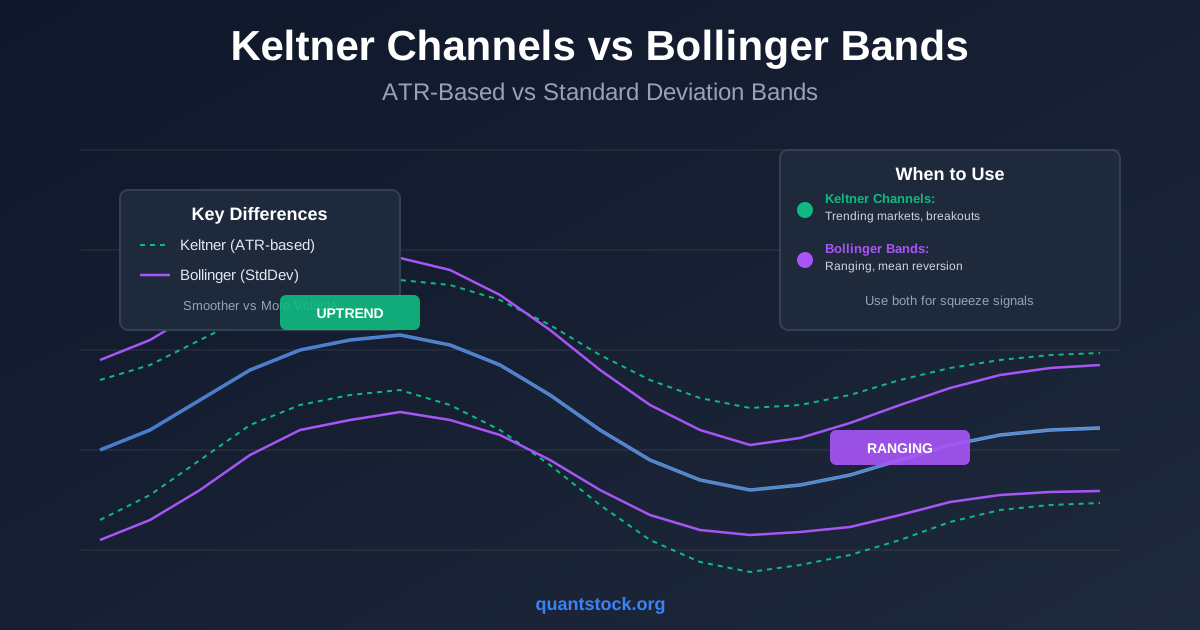
Both Keltner Channels and Bollinger Bands use envelopes around price to identify overbought/oversold conditions and potential breakouts. But here's the critical difference: Bollinger Bands use standard deviation (statistical volatility), while Keltner Channels use ATR (actual price movement). This fundamental difference makes each indicator better suited for specific market conditions and trading styles.
In this comprehensive comparison, you'll learn exactly when to use Keltner Channels vs Bollinger Bands, how each indicator behaves in trending vs ranging markets, and which one generates more reliable breakout signals. We'll compare the mathematics behind each, analyze their strengths and weaknesses, and show you how combining both can create a powerful volatility-based trading system.
Understanding these differences isn't just academic—it directly impacts your trading results. Using the wrong volatility indicator for the current market regime leads to false signals, whipsaws, and poor risk management. Let's break down exactly which indicator you should be using and when.
How Keltner Channels Work
Keltner Channels consist of three lines: a middle line (typically the 20-period EMA) and upper/lower bands set at a multiple of ATR (Average True Range) above and below the middle line. The most common setting is 20 EMA with 2x ATR bands, though some traders use 1.5x or 2.5x ATR depending on volatility preferences.
Keltner Channel Formula:
- Middle Line: 20-period EMA (Exponential Moving Average)
- Upper Band: 20 EMA + (2 × ATR)
- Lower Band: 20 EMA - (2 × ATR)
Because Keltner Channels use ATR, they measure actual price movement rather than statistical deviation. ATR captures the average range of price bars, including gaps and limit moves. This makes Keltner Channels more responsive to directional volatility—when price trends strongly, ATR expands, widening the channels. When price consolidates, ATR contracts, narrowing the channels.
Key Keltner Channel Characteristics:
- Uses EMA as the middle line (faster than SMA, weighted toward recent price)
- Bands are based on ATR, which measures actual volatility directionally
- Width adjusts to current volatility conditions automatically
- Smoother bands that don't spike as dramatically as Bollinger Bands
- Excellent for trend-following strategies and breakout confirmation
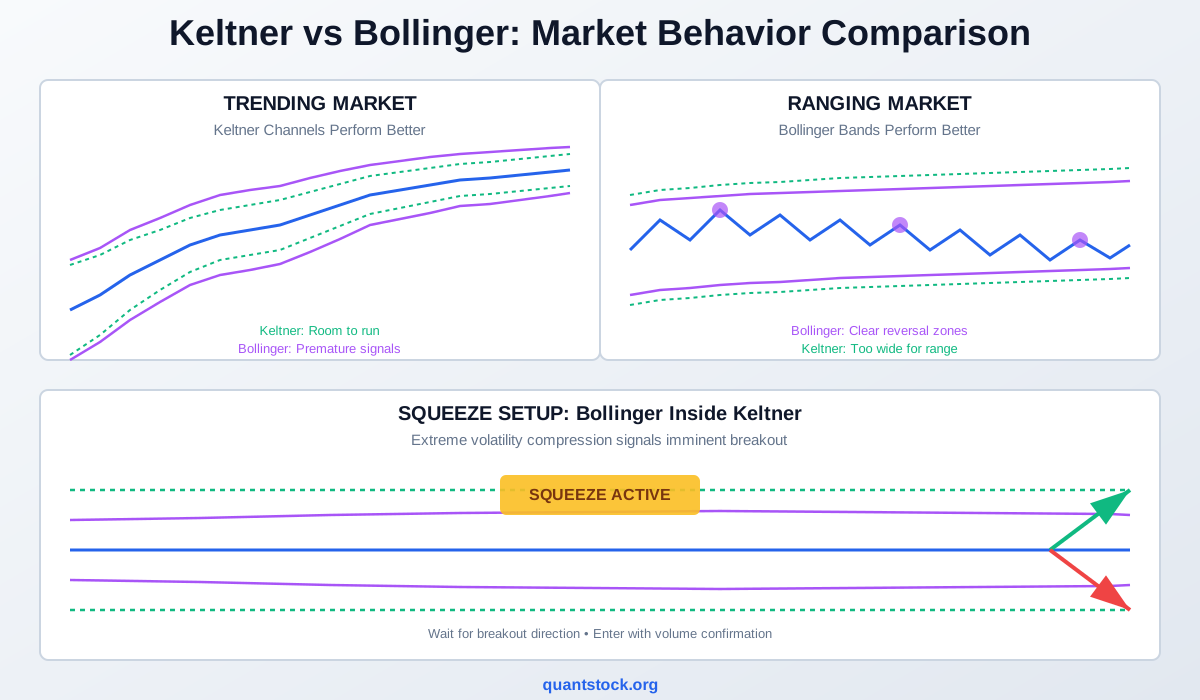
Key Insight: Keltner Channels excel in trending markets because ATR expands with directional moves, giving price room to run. The bands act as dynamic trend channels rather than reversal zones.
How Bollinger Bands Work
Bollinger Bands also consist of three lines: a middle line (20-period SMA) and upper/lower bands set at a multiple of standard deviation (typically 2) above and below the SMA. Standard deviation measures how far price deviates from its average, capturing volatility statistically rather than directionally.
Bollinger Bands Formula:
- Middle Line: 20-period SMA (Simple Moving Average)
- Upper Band: 20 SMA + (2 × Standard Deviation)
- Lower Band: 20 SMA - (2 × Standard Deviation)
Standard deviation measures dispersion—how spread out prices are from the average. When price becomes more volatile (swinging widely), standard deviation increases and Bollinger Bands widen. When price consolidates (trading in a tight range), standard deviation decreases and bands contract. This creates the famous Bollinger Band squeeze pattern.
Key Bollinger Band Characteristics:
- Uses SMA as the middle line (slower, treats all periods equally)
- Bands based on standard deviation (statistical measure of volatility)
- Width adjusts to statistical dispersion, not directional movement
- Bands can spike dramatically during high-volatility events
- Price touches the bands approximately 95% of the time (2 SD covers 95% of data in normal distribution)
- Excellent for mean reversion strategies and identifying extremes
The key difference is that Bollinger Bands measure how unusual the current price is relative to recent average, while Keltner Channels measure how much price is actually moving in absolute terms. This subtle distinction creates dramatically different trading signals.
Keltner Channels vs Bollinger Bands: Key Differences
| Feature | Keltner Channels | Bollinger Bands |
|---|---|---|
| Middle Line | 20 EMA (faster) | 20 SMA (slower) |
| Band Calculation | ATR (directional volatility) | Standard Deviation (statistical) |
| Best For | Trending markets, breakouts | Ranging markets, mean reversion |
| Smoothness | Smoother bands, gradual changes | More volatile bands, sharp spikes |
| Squeeze Behavior | Less pronounced squeeze | Dramatic squeeze (famous pattern) |
| Breakout Signals | Earlier breakout confirmation | Later but more reliable |
| False Signals | More false signals in ranging markets | More false signals in trending markets |
| Typical Settings | 20 EMA, 2.0 ATR | 20 SMA, 2.0 StdDev |
When to Use Keltner Channels
Keltner Channels shine in trending markets where you want to ride momentum rather than fade extremes. Because they use ATR, the bands expand with the trend, giving price room to continue rather than signaling overbought/oversold prematurely. This makes them ideal for trend-following systems.
Best Use Cases for Keltner Channels:
- Strong Trending Markets: When price is clearly trending, Keltner Channels act as dynamic support/resistance that moves with the trend. Price walking along the upper Keltner band in an uptrend is a sign of strength, not a reversal signal
- Breakout Confirmation: When price breaks outside Keltner Channels and closes beyond the band, it signals strong momentum. This is especially powerful when combined with volume confirmation. See our Bollinger Bands squeeze strategy for complementary breakout techniques
- Trailing Stops for Trends: Use the opposite Keltner band as a trailing stop. In an uptrend, exit if price closes below the lower Keltner band. This keeps you in trends longer than fixed stops
- Volatility Expansion Plays: When Keltner Channels widen significantly, it signals expanding volatility and often the start of a new trend. Enter in the direction of the expansion
- Trend Strength Filter: If price consistently stays above the middle line (20 EMA) and touches the upper band, the uptrend is strong. If price can't reach the upper band, the trend is weakening
Keltner Channel Trading Strategy:
- Wait for price to break above the upper Keltner Channel with a strong close
- Confirm with volume spike (1.5x average or higher)
- Enter long on the next candle open or on a small pullback to the upper band
- Place stop below the 20 EMA or the lower Keltner band
- Take profits when price closes back inside the channel or at predetermined targets
When to Use Bollinger Bands
Bollinger Bands excel in ranging, mean-reverting markets where price oscillates between extremes. Because they use standard deviation, band touches signal statistical extremes—price has deviated unusually far from the mean and is likely to revert. This makes them powerful for counter-trend and range-bound strategies.
Best Use Cases for Bollinger Bands:
- Range-Bound Markets: When price is oscillating in a range, Bollinger Bands identify the edges. Buy at the lower band, sell at the upper band. In ranging conditions, this generates consistent profits as price reverts to the mean (20 SMA)
- Bollinger Band Squeeze: When bands contract to multi-month tightness, it signals low volatility that precedes explosive moves. The direction of the eventual breakout is unpredictable, but the magnitude is often significant. Learn more in our complete Bollinger Bands squeeze guide
- Overbought/Oversold Reversals: When price touches or exceeds the upper Bollinger Band in a ranging market, it's statistically overbought. When combined with RSI divergence or other reversal signals, this creates high-probability short setups. Inverse for lower band touches
- Walking the Bands: In strong trends, price "walks" the upper or lower Bollinger Band—repeatedly touching it without reverting to the mean. This signals exceptional strength and continuation likelihood. Don't fade the band in these conditions
- W-Bottoms and M-Tops: Bollinger Bands are excellent for identifying classic chart patterns. A W-bottom forms when price touches the lower band twice without breaking it, signaling accumulation. M-tops form at the upper band
Bollinger Bands Mean Reversion Strategy:
- Identify a ranging market (price oscillating between clear support/resistance)
- Wait for price to touch or exceed the lower Bollinger Band
- Look for reversal confirmation: bullish candle pattern, RSI divergence, or volume spike
- Enter long targeting the 20 SMA (middle band) or upper Bollinger Band
- Stop loss below the recent swing low or 1 ATR below entry
Combining Keltner Channels and Bollinger Bands
The most powerful approach is using both indicators together to identify unique market conditions. When you overlay Keltner Channels and Bollinger Bands on the same chart, the interaction between them reveals critical information about volatility and potential breakouts.
The Squeeze Play (Both Indicators):
When Bollinger Bands contract inside Keltner Channels, it signals an extreme squeeze—volatility has compressed to unusually low levels. This "squeeze" predicts an imminent expansion and breakout. The key is waiting for the breakout direction confirmation before entering.
Squeeze Trade Rules:
- Bollinger Bands must be completely inside Keltner Channels (both upper and lower bands)
- Wait for Bollinger Bands to expand back outside Keltner Channels
- The direction of the first band to break signals the breakout direction
- Enter in the breakout direction with confirmation (volume, momentum)
- This setup often produces 2-3x average volatility moves
Breakout Confirmation:
Use Keltner Channels for early breakout signals and Bollinger Bands for confirmation. When price breaks outside Keltner Channels but hasn't yet reached the outer Bollinger Band, there's still room to run. When price reaches the Bollinger Band extreme, consider taking profits or tightening stops as the move may be exhausting.
Trend vs Range Identification:
- Trending Market: Bollinger Bands consistently wider than Keltner Channels, price walking one of the bands
- Ranging Market: Bollinger Bands and Keltner Channels roughly parallel, price oscillating between the outer bands of each
- Transition Zone: Bollinger Bands contracting inside Keltner Channels—uncertainty, avoid trading or prepare for breakout
Test different combinations on your preferred instruments using our free backtesting tool to find which volatility approach works best for your trading style and market conditions.
Which Indicator Generates Better Signals?
Neither indicator is universally "better"—they excel in different conditions. The key is matching the indicator to the current market regime.
Keltner Channels Win When:
- Markets are trending strongly (ADX > 25)
- You're trading breakouts and momentum strategies
- You want smoother, less noisy signals
- You're using the bands as trailing stops in trends
- You prefer earlier breakout entry signals (accept more false positives for earlier entries)
Bollinger Bands Win When:
- Markets are range-bound or choppy (ADX < 20)
- You're trading mean reversion and fading extremes
- You want to identify statistical extremes and outliers
- You're looking for squeeze patterns and volatility expansion setups
- You prefer higher-probability signals (accept later entries for better win rate)
Backtesting Results Insights:
Empirical studies show that Keltner Channels produce more signals with lower win rate but higher profit factor in trending markets. Bollinger Bands produce fewer signals with higher win rate but smaller average wins in ranging markets. The best approach is using ADX or market regime filters to switch between them dynamically.
Related Volatility and Momentum Strategies
Bollinger Bands Squeeze Strategy
Master the Bollinger Band squeeze pattern—when bands contract to extreme tightness before explosive breakouts. Learn how to identify genuine squeezes, confirm breakout direction, and capture the high-volatility expansion moves that follow.
Learn Squeeze Strategy →ATR Stop Loss Strategy Guide
ATR (Average True Range) is the foundation of Keltner Channels. Learn how to use ATR independently for volatility-adjusted stop loss placement, position sizing, and dynamic risk management that adapts to current market conditions.
Master ATR Stop Loss →ADX Indicator: Trend Strength Filter
Use ADX to determine whether to trade Keltner Channels (trending markets) or Bollinger Bands (ranging markets). ADX above 25 signals use Keltner for breakouts; ADX below 20 signals use Bollinger Bands for mean reversion.
Learn ADX Filtering →Frequently Asked Questions
What's the main difference between Keltner Channels and Bollinger Bands?
Keltner Channels use ATR (Average True Range) to measure actual price movement, while Bollinger Bands use standard deviation to measure statistical volatility. This makes Keltner Channels better for trending markets and breakouts, while Bollinger Bands excel in ranging markets and mean reversion strategies. The middle line also differs: Keltner uses 20 EMA (faster), Bollinger uses 20 SMA (slower).
Can you use Keltner Channels and Bollinger Bands together?
Yes, combining both creates powerful squeeze setups. When Bollinger Bands contract completely inside Keltner Channels, it signals extreme volatility compression that precedes major breakouts. The first band to expand outside the other indicates the breakout direction. This combination also helps identify market regime—if Bollinger Bands are consistently wider than Keltner, the market is trending strongly.
Which indicator is better for day trading?
For intraday trending moves and breakouts, Keltner Channels are generally superior because they respond faster to directional momentum. For range-bound intraday trading and fading extremes, Bollinger Bands work better. Many day traders use both: Keltner for trend direction and Bollinger for entry/exit timing within the trend.
What are the best settings for Keltner Channels?
The standard Keltner Channel setting is 20 EMA with 2.0 ATR multiplier for the bands. Aggressive traders use 1.5 ATR for tighter bands and more signals. Conservative traders use 2.5 or 3.0 ATR for wider bands and fewer false breakouts. Test different settings through backtesting to find what works for your trading style and instruments.
Do Bollinger Bands work better than Keltner Channels for reversals?
Yes, Bollinger Bands are superior for reversal trading in ranging markets because standard deviation identifies statistical extremes where mean reversion is likely. When price touches the outer Bollinger Band in a range, it signals an overbought/oversold condition. Keltner Channels, by contrast, can stay wide during trends, making band touches less significant for reversals.
Conclusion: Choose Based on Market Conditions
Keltner Channels vs Bollinger Bands isn't about which indicator is better—it's about which fits the current market regime. Keltner Channels excel in trending, directional markets where you want to ride momentum and use the bands as dynamic support/resistance. Bollinger Bands dominate in ranging, mean-reverting conditions where statistical extremes signal reversal opportunities.
The most sophisticated approach is using both together. Let Bollinger Band squeezes inside Keltner Channels identify low-volatility compression zones before breakouts. Use Keltner for breakout entries and Bollinger for profit targets. Let ADX tell you which indicator to emphasize—when ADX is high, favor Keltner's trend-following signals; when ADX is low, favor Bollinger's mean reversion setups.
Ready to compare Keltner Channels vs Bollinger Bands with real data? Start backtesting now to test which volatility indicator generates better results for your trading style, timeframe, and preferred instruments. Measure win rates, average wins vs losses, and max drawdown to make data-driven decisions about which bands to trust.